The short answer
If you are asking how many drops of methylene blue to take, the honest answer is that drops are the wrong unit. Liquid methylene blue sold online rarely lists a verified concentration, so a few drops can mean very different amounts from one bottle to the next. In research and in clinical use, methylene blue for cognitive and mitochondrial support is measured in milligrams and used at low doses — a Healthspan protocol typically starts at around 5 mg per day and increases gradually to a maximum of about 25 mg per day, taken as encapsulated capsules and set by a licensed clinician. It is used off-label, so the right amount for you is a clinical decision, not a fixed number of drops.

With methylene blue, the dose is the whole question

What a safe methylene blue dose depends on
Your body and medications
Methylene blue interacts with serotonergic medications such as SSRIs and MAOIs and is not suitable for people with G6PD deficiency or during pregnancy. Screening changes what is safe for you.



The amount, in milligrams
Off-label protocols use low doses — commonly starting near 5 mg per day and titrated to a maximum of about 25 mg per day. Milligrams, not drops, are how the dose is defined.
The form you take
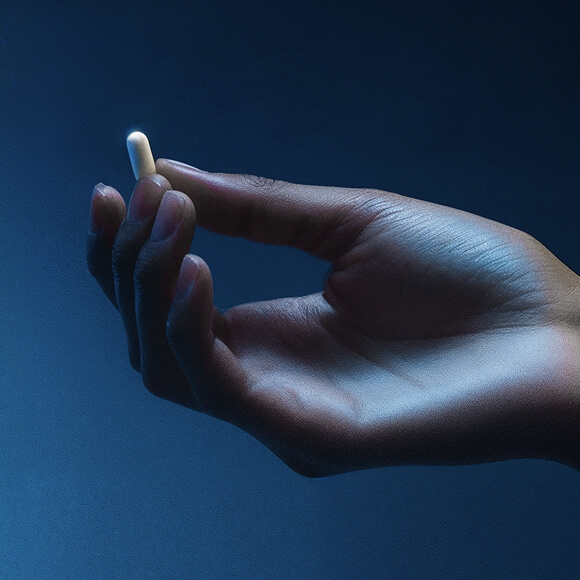
An encapsulated, quality-controlled capsule delivers a known amount every time — unlike counting drops from a bottle of liquid whose strength you cannot verify.
The amount, in milligrams
Off-label protocols use low doses — commonly starting near 5 mg per day and titrated to a maximum of about 25 mg per day. Milligrams, not drops, are how the dose is defined.
Your body and medications
Methylene blue interacts with serotonergic medications such as SSRIs and MAOIs and is not suitable for people with G6PD deficiency or during pregnancy. Screening changes what is safe for you.
The form you take
An encapsulated, quality-controlled capsule delivers a known amount every time — unlike counting drops from a bottle of liquid whose strength you cannot verify.





The research on low-dose methylene blue
How methylene blue's effect on brain metabolism and memory has been studied — at low doses, measured in milligrams.
Low-dose methylene blue and the human brain: a randomized fMRI trial (Radiology, 2016)
Methylene blue improves brain oxidative metabolism and memory retention in rats (Pharmacol Biochem Behav, 2004)
Extinction memory improvement by the metabolic enhancer methylene blue (Learn Mem, 2004)
Common questions about methylene blue dosage
There is no reliable "number of drops," because drops are the wrong unit. Liquid methylene blue sold online rarely lists a verified concentration, so the same "few drops" can deliver very different amounts from one bottle to the next — and much of that liquid is a lab or research chemical labeled "not for human consumption." Methylene blue used for cognitive and mitochondrial support is measured in milligrams and used at low doses. Healthspan dispenses it as encapsulated capsules with a milligram dose a licensed clinician sets and adjusts, so you are not counting drops or guessing the strength.
For off-label cognitive and mitochondrial support, methylene blue is used at low doses. A typical Healthspan protocol starts at around 5 mg per day and increases gradually to a maximum of about 25 mg per day, personalized by a licensed clinician based on your goals, health history, and how you respond. This is background on how the medication is dosed, not a recommendation for you to take any specific amount — the right dose is a clinical decision.
No. The cognitive and mitochondrial effects studied in research come from low doses measured in milligrams, and more is not better. Higher amounts of methylene blue are used for different, FDA-approved medical purposes and can behave very differently in the body, including a higher chance of side effects. That is a key reason dosing is kept low and set by a clinician rather than self-escalated.
An encapsulated, quality-controlled capsule delivers a known milligram amount every time, which is exactly what a dropper of unregulated liquid cannot promise. Healthspan methylene blue is an encapsulated oral formulation with a customized 5–25 mg dose, so your intake is consistent and the amount is something a clinician can adjust deliberately rather than by counting drops.
At the low doses used for off-label support, reported effects are usually mild — such as nausea, dizziness, or headache — and urine commonly turns blue-green, which is harmless. Methylene blue can interact with serotonergic medications, including some antidepressants (SSRIs and MAOIs), where it may contribute to serotonin syndrome; it is not suitable for people with G6PD deficiency and is not appropriate during pregnancy or with certain conditions. A licensed clinician screens for these before prescribing and monitors you over time.
The right amount depends on your body, your goals, and the medications you already take — which is why a fixed number can’t be given online. A licensed clinician reviews your history and current medications, decides whether methylene blue is appropriate, sets a low starting dose (typically around 5 mg), and titrates gradually toward a maximum of about 25 mg per day while monitoring how you respond. The 2-minute assessment is where that review starts.
There is no reliable "number of drops," because drops are the wrong unit. Liquid methylene blue sold online rarely lists a verified concentration, so the same "few drops" can deliver very different amounts from one bottle to the next — and much of that liquid is a lab or research chemical labeled "not for human consumption." Methylene blue used for cognitive and mitochondrial support is measured in milligrams and used at low doses. Healthspan dispenses it as encapsulated capsules with a milligram dose a licensed clinician sets and adjusts, so you are not counting drops or guessing the strength.
For off-label cognitive and mitochondrial support, methylene blue is used at low doses. A typical Healthspan protocol starts at around 5 mg per day and increases gradually to a maximum of about 25 mg per day, personalized by a licensed clinician based on your goals, health history, and how you respond. This is background on how the medication is dosed, not a recommendation for you to take any specific amount — the right dose is a clinical decision.
No. The cognitive and mitochondrial effects studied in research come from low doses measured in milligrams, and more is not better. Higher amounts of methylene blue are used for different, FDA-approved medical purposes and can behave very differently in the body, including a higher chance of side effects. That is a key reason dosing is kept low and set by a clinician rather than self-escalated.
An encapsulated, quality-controlled capsule delivers a known milligram amount every time, which is exactly what a dropper of unregulated liquid cannot promise. Healthspan methylene blue is an encapsulated oral formulation with a customized 5–25 mg dose, so your intake is consistent and the amount is something a clinician can adjust deliberately rather than by counting drops.
At the low doses used for off-label support, reported effects are usually mild — such as nausea, dizziness, or headache — and urine commonly turns blue-green, which is harmless. Methylene blue can interact with serotonergic medications, including some antidepressants (SSRIs and MAOIs), where it may contribute to serotonin syndrome; it is not suitable for people with G6PD deficiency and is not appropriate during pregnancy or with certain conditions. A licensed clinician screens for these before prescribing and monitors you over time.
The right amount depends on your body, your goals, and the medications you already take — which is why a fixed number can’t be given online. A licensed clinician reviews your history and current medications, decides whether methylene blue is appropriate, sets a low starting dose (typically around 5 mg), and titrates gradually toward a maximum of about 25 mg per day while monitoring how you respond. The 2-minute assessment is where that review starts.
Methylene blue is a prescription medication that is FDA-approved for specific uses such as methemoglobinemia. Its use for cognitive and mitochondrial support is off-label, and the dosing described here is general background — not a recommendation or a dose to self-administer. A licensed clinician determines whether methylene blue is appropriate for you and sets and adjusts any dose based on your history, medications, and goals; not everyone qualifies, it is not suitable for people with G6PD deficiency, and it can interact with certain medications. This page is educational and not medical advice, and individual results vary. Medically reviewed by the Healthspan Clinical Team on 2026-08-10.