The short answer
TRT is not a weight-loss drug. In men with clinically low testosterone, restoring levels is associated in research with a shift in body composition — a move toward less fat and more lean muscle — and effects on fat distribution and insulin sensitivity that appear gradually. Because muscle is denser than fat, the scale may barely move even as body composition changes. And none of it applies to men whose testosterone is already normal. If weight loss itself is the goal, metabolic care is the studied route — testosterone is prescribed off-label here, only after a clinician confirms it is appropriate.
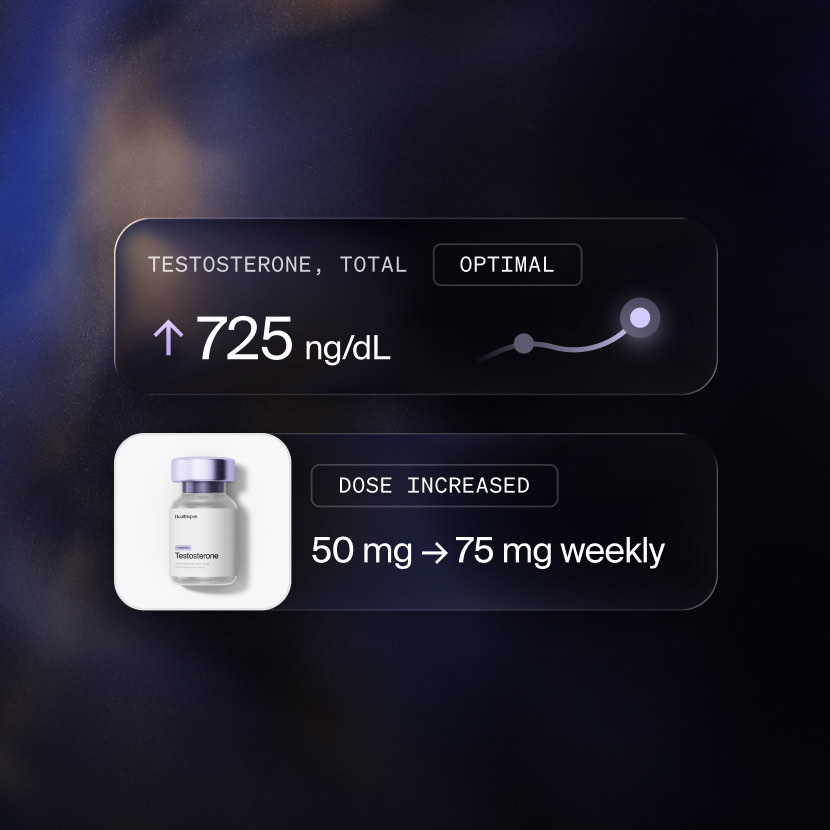

Testosterone and body composition, honestly

Weight loss vs. body composition: which lever fits
Metabolic care drives weight loss
If the goal is losing weight, the interventions actually designed and tested for it are metabolic — GLP-1 medication, metformin and structured lifestyle change. That is a different protocol from TRT.



Testosterone tunes composition
For diagnosed low testosterone, therapy is studied for its effect on fat distribution, lean muscle and insulin sensitivity — a composition lever, prescribed off-label and only after clinician review.
Both sit on lifestyle
Nutrition, resistance training, sleep and alcohol move both testosterone and weight. Any medication is one lever among several, and whether any fits you is a clinician’s decision.
Testosterone tunes composition
For diagnosed low testosterone, therapy is studied for its effect on fat distribution, lean muscle and insulin sensitivity — a composition lever, prescribed off-label and only after clinician review.
Metabolic care drives weight loss
If the goal is losing weight, the interventions actually designed and tested for it are metabolic — GLP-1 medication, metformin and structured lifestyle change. That is a different protocol from TRT.
Both sit on lifestyle
Nutrition, resistance training, sleep and alcohol move both testosterone and weight. Any medication is one lever among several, and whether any fits you is a clinician’s decision.








Go deeper on the science
Explore how testosterone therapy, body composition and muscle are studied — and where metabolic care fits when weight loss is the goal.
Testosterone optimization in males for healthspan extension
Testosterone replacement therapy for men: when it is warranted
Enclomiphene vs testosterone therapy: which is right for you?
Why older adults build less muscle from the same protein
Common questions about TRT and weight
Not directly. Testosterone replacement therapy is not a weight-loss treatment and is not approved for one. In men with clinically low testosterone, research has associated restoring testosterone with changes in body composition — a shift toward less fat mass and more lean muscle — but the number on the scale may not move much, because muscle is denser than fat. Any effect is gradual, modest, and specific to men who are genuinely deficient.
Testosterone influences how the body builds muscle and stores fat. The testosterone PDPs describe therapy as supporting "lean muscle mass, strength, bone density, and healthier fat distribution over time," with effects on muscle synthesis, fat distribution and insulin sensitivity appearing gradually. That is a body-composition shift, studied in men with low testosterone — not a promise of weight loss, and not the same thing as a fat-burning drug.
There is no evidence that adding testosterone helps men whose levels are already normal, and doing so carries risk without a clinical reason. TRT is intended for men with clinically low testosterone confirmed by blood testing plus symptoms. A licensed clinician reviews your labs and history and will tell you if your testosterone is not the issue.
No. Testosterone replacement therapy is FDA-approved only for diagnosed hypogonadism (clinically low testosterone). Using it for weight loss, general wellness or "anti-aging" is off-label. Healthspan does not promise weight-loss outcomes from TRT — a clinician determines whether testosterone therapy is medically appropriate based on your labs and symptoms.
If losing weight is the primary goal, the studied path is metabolic care, not testosterone. Approaches like GLP-1 medication, metformin and lifestyle change are the interventions designed and tested for weight loss and blood-sugar control. Healthspan runs metabolic-health care for exactly that, and the 2-minute assessment can point you to the right track — hormones, metabolism, or both.
Comprehensive lab testing is required before starting testosterone therapy and continues throughout care — Healthspan tracks 70+ biomarkers across nine biological systems, including sex hormones, blood counts, prostate markers, metabolic function and cardiovascular risk, and hematocrit is routinely monitored. Testosterone is delivered as a twice-weekly subcutaneous injection of testosterone cypionate or a daily transdermal gel, with dosing individualized and adjusted over time. It is not recommended for men actively trying to conceive, as it can suppress fertility.
Not directly. Testosterone replacement therapy is not a weight-loss treatment and is not approved for one. In men with clinically low testosterone, research has associated restoring testosterone with changes in body composition — a shift toward less fat mass and more lean muscle — but the number on the scale may not move much, because muscle is denser than fat. Any effect is gradual, modest, and specific to men who are genuinely deficient.
Testosterone influences how the body builds muscle and stores fat. The testosterone PDPs describe therapy as supporting "lean muscle mass, strength, bone density, and healthier fat distribution over time," with effects on muscle synthesis, fat distribution and insulin sensitivity appearing gradually. That is a body-composition shift, studied in men with low testosterone — not a promise of weight loss, and not the same thing as a fat-burning drug.
There is no evidence that adding testosterone helps men whose levels are already normal, and doing so carries risk without a clinical reason. TRT is intended for men with clinically low testosterone confirmed by blood testing plus symptoms. A licensed clinician reviews your labs and history and will tell you if your testosterone is not the issue.
No. Testosterone replacement therapy is FDA-approved only for diagnosed hypogonadism (clinically low testosterone). Using it for weight loss, general wellness or "anti-aging" is off-label. Healthspan does not promise weight-loss outcomes from TRT — a clinician determines whether testosterone therapy is medically appropriate based on your labs and symptoms.
If losing weight is the primary goal, the studied path is metabolic care, not testosterone. Approaches like GLP-1 medication, metformin and lifestyle change are the interventions designed and tested for weight loss and blood-sugar control. Healthspan runs metabolic-health care for exactly that, and the 2-minute assessment can point you to the right track — hormones, metabolism, or both.
Comprehensive lab testing is required before starting testosterone therapy and continues throughout care — Healthspan tracks 70+ biomarkers across nine biological systems, including sex hormones, blood counts, prostate markers, metabolic function and cardiovascular risk, and hematocrit is routinely monitored. Testosterone is delivered as a twice-weekly subcutaneous injection of testosterone cypionate or a daily transdermal gel, with dosing individualized and adjusted over time. It is not recommended for men actively trying to conceive, as it can suppress fertility.
This page is educational and not medical advice. Testosterone replacement therapy is a prescription treatment approved only for men with diagnosed hypogonadism (clinically low testosterone); use for weight loss, general wellness, or “anti-aging” is off-label, and TRT is not a weight-loss treatment. Body-composition effects come from research in men who are clinically deficient and vary from person to person. A licensed clinician determines whether testosterone therapy is appropriate for you based on your labs and symptoms; not everyone qualifies. Medically reviewed by the Healthspan Clinical Team on 2026-09-16.