Older Adults Build 40% Less Muscle From the Same Protein. A New Model Shows Why Fixing One Thing at a Time Keeps Failing.
Prefer to listen? Hit play for a conversational, audio‑style summary of this article’s key points.
Older adults build dramatically less muscle from the same protein. Give a younger and an older adult an identical dose of amino acids, and the older person's muscle synthesizes roughly 40% less new muscle protein, about 0.27 grams of leucine versus 0.46 grams in younger adults, from the same input. This blunted response, called anabolic resistance, is a central driver of the muscle loss that erodes strength and independence with age.
Single interventions keep failing, and a new model explains why. More protein, extra leucine, and various drugs have all shown limited, inconsistent success against anabolic resistance. A study in The Journal of Physiology used a computational model of the entire muscle-building system, calibrated to human data, to test each suspected cause alone and in combination, and found the reason single fixes underdeliver.
Anabolic resistance is not one broken mechanism but several at once. The model tested the age-related impairments individually: the gut extracting more amino acids (up ~76%), less amino acid reaching muscle (down ~27%), weaker insulin signalling (~20%), less mTOR (~21%), a less sensitive mTOR hub (~43% weaker), and less of the downstream messenger p70S6K (~22%). Alone, only reduced mTOR sensitivity mattered much. Together, they compounded to reproduce the full deficit.
This is why fixing one thing at a time doesn't work. When the model simulated all the impairments together, as they presumably occur in a real older adult, no single fix restored muscle building. Only combinations, restoring several targets at once, brought it back to healthy levels. A therapy that corrects one mechanism will always fall short if others remain impaired, which explains the field's long history of disappointing single-target treatments.
The model found a surprising compensation. Aging muscle keeps its growth signalling chronically switched on at rest, running at nearly twice the level of young muscle even between meals. Far from being a malfunction, this compensation actually props up muscle protein synthesis in the model, partially rescuing a failing system. It may, however, leave less room for the signal to rise when a meal arrives, though that tradeoff is a reasonable interpretation rather than a proven result.
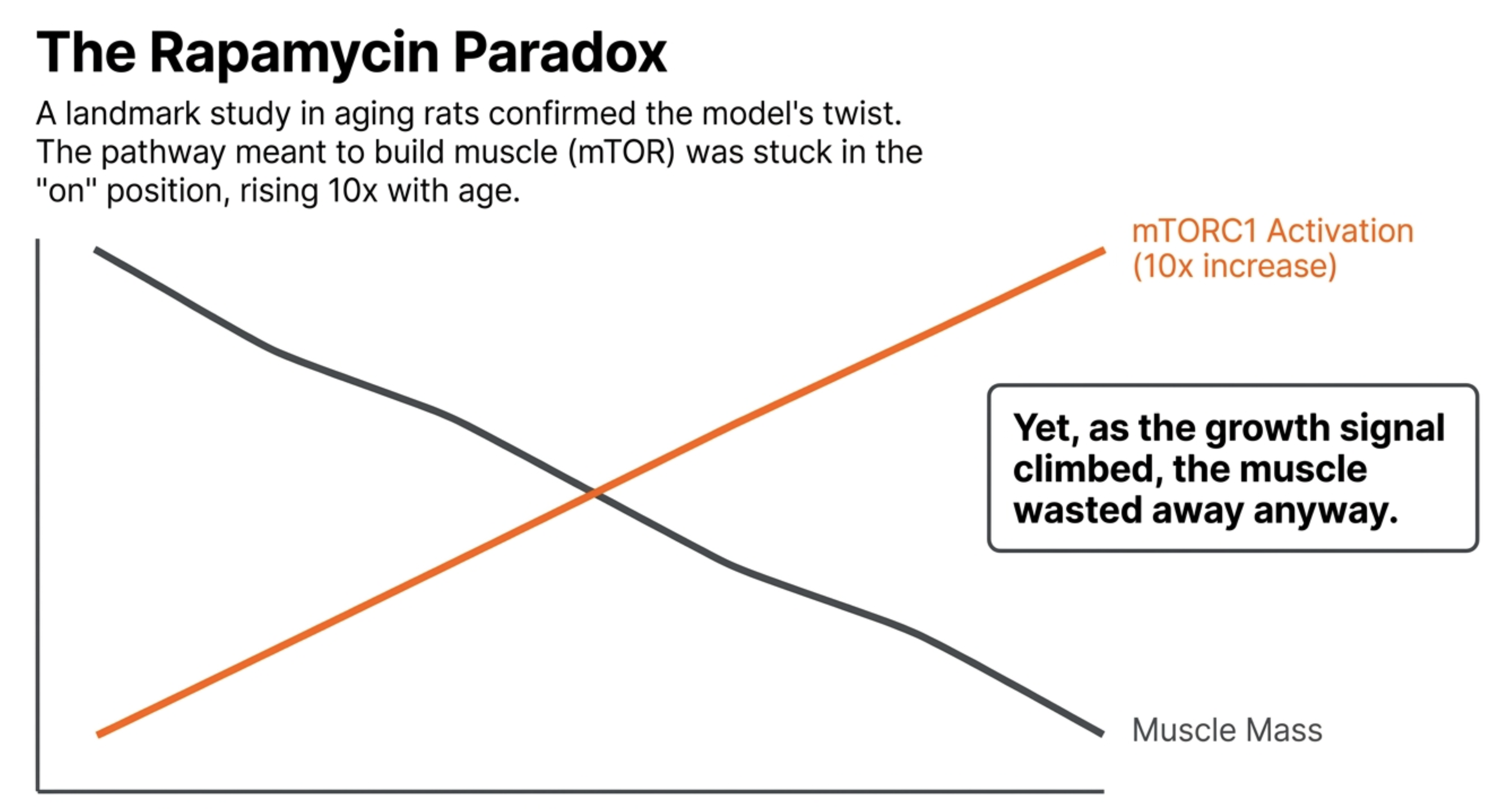
A separate study found the same chronic overactivation, and a counterintuitive fix. In aging rats, mTOR signalling was not underactive but dramatically hyperactivated, rising about tenfold with age while muscle mass fell. Treating the rats with a low, partial dose of a rapamycin-like drug (RAD001) increased muscle mass in some muscles and reversed molecular signatures of aging, senescence markers, breakdown enzymes, and signs of nerve-muscle disconnection all declined.
The dose was everything, and it points to why this needs medical guidance. Only the low, partial dose helped; a high, near-complete inhibition of mTOR did nothing for muscle. The benefit was also muscle-specific and worked partly by restoring the cell's cleanup system, autophagy. This narrow therapeutic window is exactly why rapamycin, one of longevity medicine's most watched molecules, calls for careful clinician-guided dosing rather than self-experimentation.
The problem may be too much mTOR signalling at the wrong time, not too little. The two studies converge on a reframing: aging muscle isn't failing for lack of growth signalling, but from a growth pathway stuck chronically on, which may leave it less able to respond to a meal. The counterintuitive implication is that carefully dialing that pathway down could help restore the muscle's dynamic response, quiet the idle so it can surge when fed.
The most powerful multi-target intervention available today isn't a drug. The model shows that beating a multifactorial problem requires hitting several mechanisms at once, which is exactly what protein plus resistance exercise does. Resistance training re-sensitizes the mTOR hub to leucine, while adequate, leucine-rich protein spread across the day supplies more of the signal. Together they act on the sensitivity and the availability at the same time, the combination the model says is required.
These are model predictions, and the window to act is earlier than you think. The findings come from a computational model built on male data using purified amino acids, not real meals, so they generate hypotheses rather than prove them, and the rapamycin evidence is from rats. But the practical lesson holds: anabolic resistance is not a switch that flips in old age but a slope that builds over decades, so the trajectory of your muscle in your seventies and eighties is shaped in large part by how you eat and train in your forties and fifties.
Introduction: The Deficit That Won't Be Fixed
Give a healthy young adult and a healthy older adult the same protein-rich meal, and something quietly unequal happens inside their muscles. The young person's muscle takes the incoming amino acids and builds. The older person's muscle, fed identically, builds substantially less, on the order of forty percent less new muscle protein from the very same dose. The signal arrived. The raw material arrived. Yet the response fell short.
This blunted reaction has a name, anabolic resistance, and it is now understood to be a central engine of age-related muscle loss. The deficit on any single meal is small and invisible. Repeated across every meal, every day, for years, it compounds into the slow erosion of muscle that leaves older adults weaker, frailer, and more prone to the falls and loss of independence that so often mark the end of healthy life. If there is a single physiological process worth understanding for anyone who wants to age well, the muscle's fading response to protein is a strong candidate.
The frustrating thing is how stubbornly it has resisted fixing. Researchers have thrown the obvious tools at it. Give older adults more protein. Add extra leucine, the amino acid that most strongly triggers muscle building. Try drugs aimed at the muscle's growth pathways. Each approach has shown some effect in some studies, but the overall track record is one of disappointment, single interventions that looked promising and then underdelivered, again and again. For a problem this important, the repeated failure of the obvious solutions is a puzzle in its own right. Why does fixing the thing that seems broken so rarely restore the muscle's response?
A study in The Journal of Physiology set out to answer that question with an unusual tool. Rather than running yet another experiment on yet another single mechanism, the researchers built a mathematical model of the entire muscle-protein-building system, calibrated to real human data, and used it to do what no single experiment can: switch each suspected cause of anabolic resistance on and off, alone and in every combination, and measure exactly how much each one contributes. It is a way of interrogating the whole tangled system at once, to find out not just which parts are failing, but how they fail together.
The answer reframes the problem entirely, and it explains the long history of disappointment. Anabolic resistance, the model indicates, is not one broken part. It is several modest failures happening at the same time, each small enough to seem survivable on its own, compounding into a deficit that no single one of them could produce. And that has an uncomfortable consequence: if the problem is multifactorial, then a fix aimed at any single mechanism is almost designed to fail, because it leaves the others untouched. What follows is how the model reached that conclusion, the genuinely surprising thing it found about how aging muscle tries to compensate, and why that surprise leads, by a paradoxical route, straight to one of the most discussed molecules in all of longevity medicine.
How Muscle Is Built and Lost
To understand what fails in aging muscle, you first have to see that muscle is never static. The muscle you carry is not a fixed structure but a balance, one that is being continuously torn down and rebuilt, every hour of every day.
Muscle is made largely of protein, and that protein exists in constant turnover. Two opposing processes run at all times. One is muscle protein synthesis, the building of new muscle protein. The other is muscle protein breakdown, the dismantling of existing protein back into its component amino acids. Both happen continuously, and the amount of muscle you have at any moment is simply the running balance between them. When synthesis outpaces breakdown, muscle grows. When breakdown outpaces synthesis, it shrinks. When the two match, muscle holds steady. Maintaining muscle, then, is not a matter of doing nothing; it is a matter of continuously winning a tug-of-war between building up and breaking down.
This balance shifts across the day, and the thing that shifts it most is eating. In the hours after a protein-rich meal, amino acids flood the bloodstream, muscle protein synthesis surges, and the balance tips toward building. In the fasted stretches between meals and overnight, the balance drifts back toward breakdown. A healthy young adult moves through this cycle continuously, and the meal-driven surges of synthesis are large enough to offset the fasted-state losses. Over time, the books balance, and muscle is preserved.
One molecule matters more than any other for driving the building half of that cycle: leucine. Among the twenty amino acids, leucine is the key trigger, the one that most strongly signals to muscle that a protein-rich meal has arrived and synthesis should ramp up. This is why leucine sits at the center of so much muscle research, and why it is central to the model this study is built on. To a large degree, the muscle's response to a meal is its response to leucine.
That response runs through a specific piece of molecular machinery, one that we spend a lot of time discussing at Healthspan because of its role in cellular aging. It is worth discussing this machinery because nearly everything that follows converges on it. When leucine arrives, it activates a hub called mTOR, and more precisely the complex it forms known as mTORC1.
This is why leucine stands out among the twenty amino acids: beyond being raw material for building protein, it acts as a direct chemical signal, sensed by the mTORC1 machinery and uniquely able to stimulate it, so that leucine's arrival is read by the cell as the cue to begin building.
Think of mTORC1 as the master switch for muscle building, and more broadly the cell's central hub for growth, or anabolism. When it senses that leucine and other nutrients for growth are present, it switches on, and it activates a downstream messenger called p70S6K, which in turn drives the machinery that assembles new muscle protein. Leucine flips the switch, the switch activates the messenger, the messenger builds the muscle. Hold onto that simple chain, because anabolic resistance, as we will see, is largely a story of that chain responding too weakly to the signal that should set it in motion.
So muscle is maintained by a daily rhythm: protein arrives, leucine signals, mTORC1 switches on, synthesis surges, and the muscle lost to the fasted hours is rebuilt. Win that cycle consistently, and muscle endures. The quiet tragedy of anabolic resistance is that aging degrades the building half of the response, so that even when the protein and the leucine are all present, the muscle no longer answers as it should.
What Anabolic Resistance Is, and the Suspects
Anabolic resistance is, at its core, a failure of response. The signal arrives, but the muscle answers weakly.
Return to the daily rhythm. In a young adult, a protein-rich meal produces a large, decisive surge of muscle protein synthesis, more than enough to offset the day's breakdown. In an older adult with anabolic resistance, the identical meal produces a smaller, more sluggish surge. The study anchors this with a precise comparison drawn from real human data. Given an identical 15-gram dose of essential amino acids, younger men synthesized about 0.46 grams of leucine into new muscle protein over the following four hours, while older men managed only about 0.27 grams. Same input, roughly forty percent less muscle built. Both groups were healthy. The older adults were not sick or unusually frail. Their muscle simply extracted far less building from the same protein.
The question that has occupied the field is why. What, mechanically, makes older muscle answer the same signal so much more weakly? Over the years, researchers assembled a list of suspects, each with experimental support, and each representing a distinct point where the system could be failing. This study took them and gave each a specific numerical value, drawn from published measurements comparing older and younger adults, so the model could test exactly how much each one contributes. There were seven in all.
Six of them impair the building of muscle protein directly, and it is worth seeing where along the process each one strikes:
The gut and liver take a bigger cut. Before dietary amino acids ever reach the muscle, the tissues of the digestive tract and liver extract some for their own use, a process called splanchnic extraction. With age, this extraction rises by around 76 percent, so substantially more of each meal's amino acids are siphoned off before they can reach the bloodstream and the muscle.
Less amino acid crosses into the muscle. Even accounting for what the gut takes, the transport of amino acids from blood into muscle tissue falls, by roughly 27 percent, so the muscle sees a smaller supply to work with.
Insulin signals less effectively. Insulin, released with a meal, normally helps switch on the muscle's growth machinery. With age, its signalling activity drops by about 20 percent.
There is less of the master switch. The muscle contains less mTOR itself with age, around 21 percent less of the central hub that senses leucine and drives synthesis.
The switch responds less to leucine. Beyond simply having less mTOR, the remaining hub is less sensitive, its downstream output falling by roughly 43 percent for the same stimulus. This is an impairment in the machinery's responsiveness, distinct from how much of it there is.
There is less of the messenger. The muscle has roughly 22 percent less p70S6K, the downstream protein that carries the growth signal from mTORC1 toward the synthesis machinery.
The seventh suspect is different in kind, and worth separating out. It is not a failure to build but a possible increase in breakdown: the suggestion that aging muscle tears down protein faster, which would erode the net balance regardless of synthesis. The researchers tested it too, but held it apart from the other six, because the evidence that breakdown rises in healthy aging is inconsistent, and because, as we will see, the model found it did something quite different from the rest.
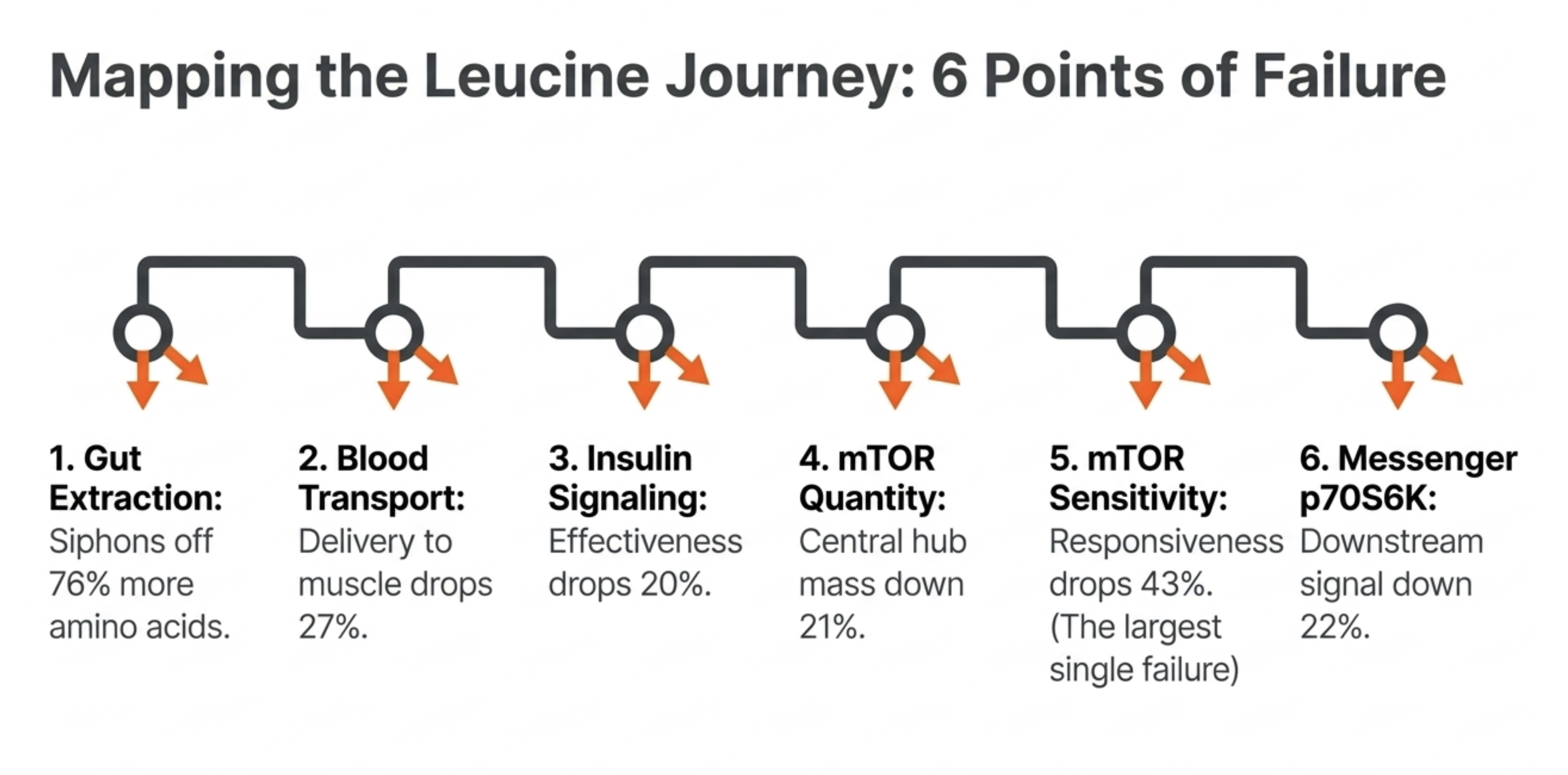
Line the first six up, and a pattern emerges that will matter enormously in a moment. These are not one big failure; they are six moderate ones, scattered across the whole length of the process, from the gut that delivers the amino acids, to the insulin that helps signal, to the amount of core machinery, to its sensitivity, to the messenger that carries its output. The damage is distributed. And that distribution is precisely the clue the field had struggled to interpret, because when researchers tried to measure how much any single one of these contributes, no individual mechanism looked big enough to explain the full deficit. Each accounted for a slice. None accounted for the whole. Which meant they had to be acting together somehow, and that is a question almost impossible to untangle in a living human being, but perfectly suited to a model.
Why Build a Model?
At this point it's worth pausing on the method, because this study is different in kind from most muscle research, and understanding why is essential to reading it correctly.
The obstacle facing anabolic resistance research is that the suspected mechanisms are hopelessly entangled in a living person. Suppose you wanted to know how much of the deficit comes from the gut taking a bigger cut, versus the mTOR hub losing sensitivity, versus there simply being less of the machinery. In a real human being, you cannot cleanly isolate one of these while holding all the others perfectly fixed. They interact. Changing one changes the others. And you cannot ethically or practically reach into a person's muscle and dial each mechanism up and down independently, in every combination, to measure its precise contribution. The system is too interconnected, and the experiments you would need are impossible to run.
This is exactly the kind of problem mathematical modelling was built for. The researchers used a computational model of muscle protein metabolism, a set of equations representing how leucine enters the system, how it is absorbed and delivered, how it activates the mTOR signalling network, how that network drives protein synthesis, and how the whole thing behaves over the hours after a meal. Crucially, this was not a model invented for this study and tuned to produce a desired answer. It was a previously built model, calibrated against real human data, plasma and intracellular leucine levels, the dynamics of the signalling proteins, measured synthesis rates, and then validated against six independent human feeding studies it had never seen during its construction. It is, in effect, a working simulation of how a human muscle responds to protein.
With a validated model in hand, the researchers could do what no human experiment allows. They could take each proposed mechanism of anabolic resistance, represent it as a specific change to the relevant part of the model, older adults have this much more splanchnic extraction, this much less mTOR, this much lower sensitivity, drawing each of those numbers from published human measurements, and then switch each one on and off at will. Alone. In every combination. With and without the others. And each time, they could read out exactly what happened to muscle protein synthesis. The model becomes an experimental system in which the impossible experiment becomes trivial: isolate any mechanism, or any group of mechanisms, and measure its precise effect.
A model's outputs are predictions, not measurements. They are only as good as the biology and the data built into it, and they describe what should happen given the model's assumptions, not what was observed in a person's muscle. The value of a study like this is not that it proves what causes anabolic resistance in your body. It is that it takes everything the field currently knows, integrates it into one coherent working system, and reveals what that combined knowledge implies, generating sharp, testable predictions about which mechanisms matter most and which combinations of fixes might work. A model is a reasoning engine, not a verdict. Read that way, what it found is genuinely illuminating, and in one respect, genuinely surprising.
No Single Culprit
With the model built and each mechanism assigned its measured value, the researchers could finally ask the question that had stymied the field: how much does each cause of anabolic resistance actually contribute, alone and together?
They approached it two ways, which is part of what makes the answer trustworthy. First, an unbiased exploration: they let the model's parameters vary across wide physiological ranges, generated thousands of virtual muscle profiles, sorted them into anabolically sensitive and anabolically resistant, and asked which parameters most distinguished the two, making no prior assumption about which mechanisms should matter. Then, a targeted test: they took the specific, literature-documented mechanisms, set each to the value measured in real older adults, and simulated their effects one at a time and in combination.
Both approaches converged on the signalling machinery inside the muscle cell, and one mechanism stood out. When the researchers imposed the measured age-related loss of mTORC1 sensitivity, the hub responding more weakly to the same leucine, muscle protein synthesis fell substantially, dropping close to the level actually observed in older adults. On its own, under the consensus estimates, this single mechanism came near to reproducing the whole deficit. It was the dominant driver.
Below it sat a tier of lesser contributors. Increased splanchnic extraction, the gut taking a bigger cut, and reduced levels of the mTOR and p70S6K proteins each produced modest declines in synthesis. And two mechanisms that had long been on the field's list of suspects turned out to matter surprisingly little: reduced blood flow and impaired insulin signalling had minimal effect on synthesis in the model. This is itself a useful finding, it suggests the field's attention should concentrate on the signalling hub and the availability of amino acids, not on blood flow or insulin resistance.
But the central result was not about ranking the mechanisms. It was about what happened when they operated together. When the researchers switched on all the mechanisms at once, as they presumably all are, to some degree, in a real older adult, the effects compounded, and muscle protein synthesis fell even further, dropping below the level typically seen in older adults. Several modest impairments, each individually survivable, stacked into a deficit larger than any one of them could produce alone.
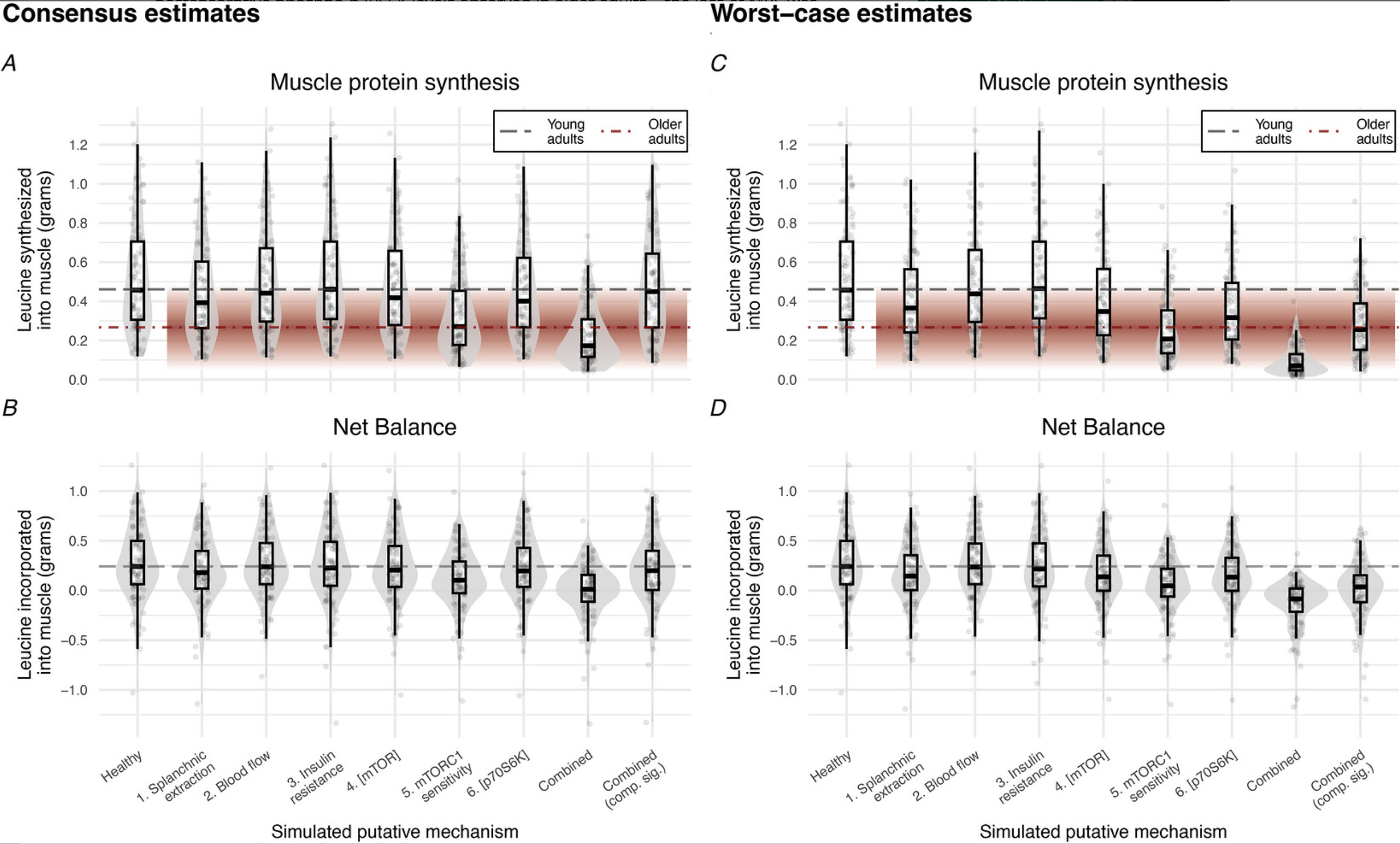
Figure 1: No single mechanism explains anabolic resistance; together they do. Simulated muscle protein synthesis after a leucine dose, with each age-related impairment applied individually and then all combined. Alone, only reduced mTORC1 sensitivity substantially lowered synthesis; combined, the impairments compounded to reproduce, and exceed, the deficit measured in older adults (red band).
This is the resolution to the puzzle that motivated the study. Researchers had struggled to find a single mechanism big enough to explain anabolic resistance because, with the partial exception of mTORC1 sensitivity, there isn't one. Anabolic resistance is multifactorial by nature. It is what you get when several moderate dysregulations accumulate in the same tissue at the same time and compound one another. The muscle doesn't stop responding to protein for one reason. It stops for several at once.
And the seventh suspect, the possible rise in muscle protein breakdown, behaved differently from all the rest, in a way that clarifies what kind of problem anabolic resistance actually is. When the researchers simulated faster breakdown, muscle protein synthesis barely changed. What shifted was the net balance, the bottom-line accounting of muscle gained versus lost, which worsened because more was being torn down, not because less was being built. This matters for how to think about the whole condition: anabolic resistance, as the term is properly used, is a failure of the building response to feeding, and that failure lives in the synthesis machinery, not in the breakdown side. Breakdown may still matter for net muscle loss over time, but it is a separate lever, and the study keeps it distinct.
Which brings us to the single most surprising thing the model found, a twist that complicates the tidy picture of six stacking failures, and that leads, unexpectedly, toward one of the most talked-about molecules in longevity medicine.
The Compensation Hidden in the Noise
The twist begins with a strange observation that had been sitting in the experimental literature, one the researchers built into their model and then had to make sense of. It concerns what aging muscle is doing while it rests, between meals, when nothing is being eaten at all.
You would expect aging muscle, with its diminished machinery and reduced sensitivity, to sit quiet at rest, its growth signalling turned low until a meal arrives to switch it on. Instead, the opposite is true. In the fasted, between-meal state, older muscle keeps one of its key growth signals, the activation of p70S6K, chronically elevated, running at nearly twice the resting level seen in young muscle. The machinery is diminished, yet it idles high. Something keeps the growth signal partly switched on even when there is nothing to respond to.
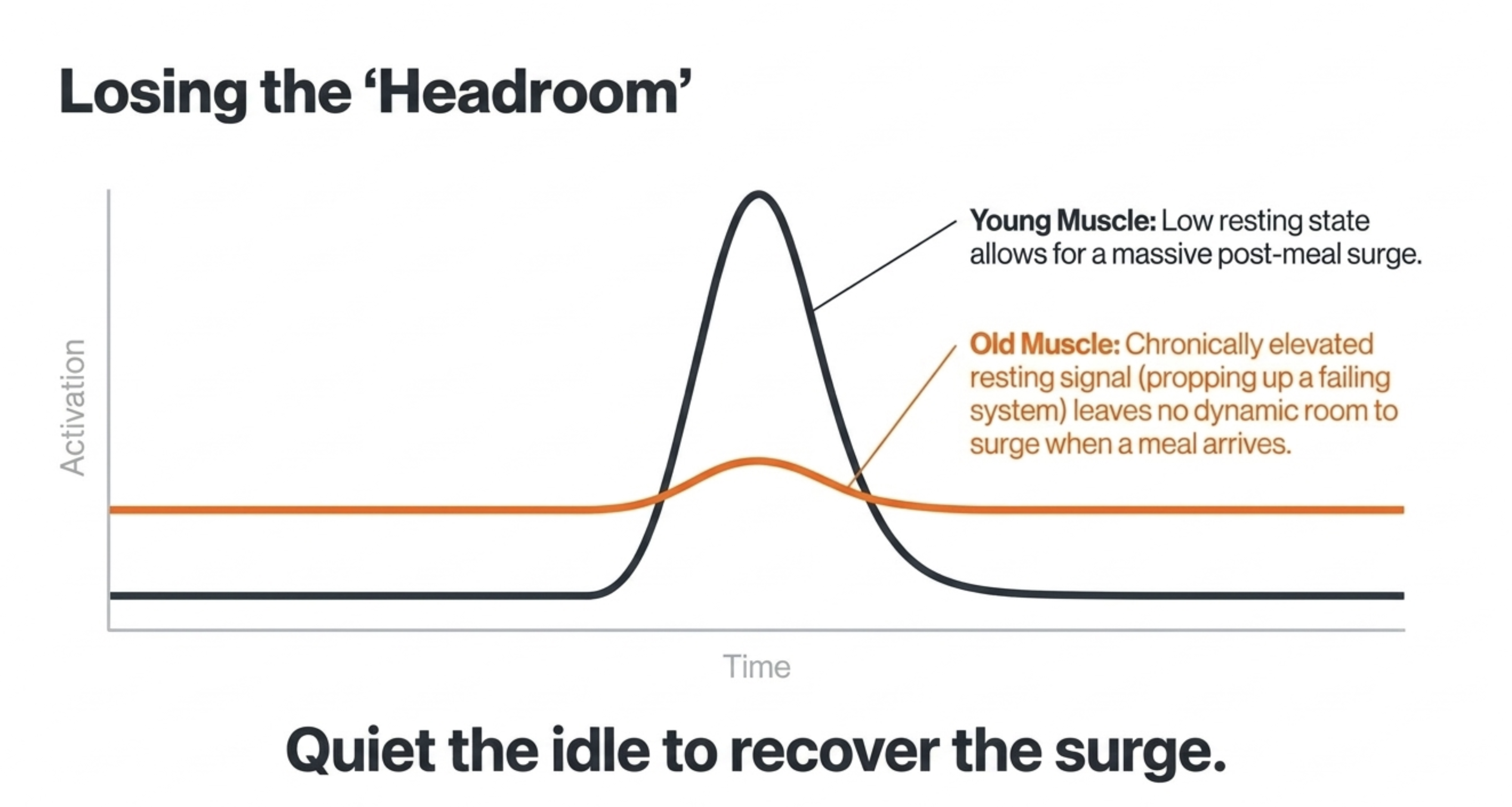
The researchers propose, and named, an explanation: compensatory signalling. The idea is that in the face of its various impairments, less machinery, reduced sensitivity, the muscle partially compensates by keeping the remaining signalling chronically active at rest, propping up a baseline of activity that would otherwise sag. And when they tested this in the model, the effect was striking, and genuinely good news. When they ran the full combination of impairments together with this elevated resting signal added in, the compensation recovered much of the lost muscle protein synthesis, pulling it back up toward healthy levels under the consensus estimates. Far from being another deficit, the compensation was doing real work. It was partially rescuing a failing system.
This is the finding to hold clearly, because it is easy to get backwards, and the paper is specific about it. The elevated resting signal is not, in the model, the primary cause of anabolic resistance. It is a response to the other impairments, and on balance a helpful one, offsetting a meaningful share of the deficit those impairments create. When researchers see older muscle idling its growth signal high, they may be seeing not a malfunction but a muscle doing its best to hold itself up.
There is, however, a plausible cost to running the engine hot at rest, and it is worth stating carefully, because here we cross from what the model directly showed into reasonable interpretation. A signal that already sits partly elevated at rest has, in principle, less room left to rise when a meal actually arrives. If the resting level is high, the peak may not climb as far above it, which would compress the dynamic swing, the very meal response that anabolic resistance describes. The model's clear, stated result is that compensation recovers synthesis; the notion that this same compensation might narrow the headroom for the meal response is a mechanistic inference the biology makes reasonable, not a separate result the paper demonstrates. Both can be true at once: a chronically elevated resting signal can prop up baseline function while also leaving less range for the post-meal surge. What the study establishes firmly is the first half, that the compensation helps.
Older muscle keeps one of its key growth signals, the activation of p70S6K, chronically elevated, running at nearly twice the resting level seen in young muscle. The machinery is diminished, yet it idles high.
Either way, the observation reframes what is happening in aging muscle. The chronically elevated signalling is not simply damage; it is, at least in part, adaptation, the muscle straining to maintain itself against a set of accumulating impairments. And that raises a genuinely provocative question, one that connects this modelling study to a large body of experimental work and to a molecule this audience knows well. If aging muscle is running its growth signalling chronically high, what happens if you turn that signalling down?
The Rapamycin Paradox
The question, turn the signalling down, sounds almost perverse in the context of muscle. Everything about the story so far says aging muscle suffers from too little effective mTOR signalling in response to a meal. Why would you want to inhibit the very pathway that builds muscle? And yet a striking study suggests that, under the right conditions, doing exactly that can help. This is the paradox at the heart of mTOR and aging muscle, and it is where the modelling study connects to one of the most discussed molecules in longevity medicine.
Rapamycin is the drug that inhibits mTOR, and it is famous in aging science for a remarkable fact: it is one of the few compounds convincingly shown to extend lifespan in mammals, largely by dialing down mTOR signalling, which in most tissues runs harmfully high with age. The intuition most people carry is that mTOR inhibition, whatever its benefits elsewhere, must be bad for muscle, since muscle needs mTOR to grow. Inhibiting the pathway has been shown to block muscle's growth response to overload. So it seemed obvious that turning mTOR down would be the last thing a wasting muscle needs. A study from the laboratory of David Glass, at Novartis, tested that assumption and found the opposite.
The researchers first mapped how mTORC1 activity actually changes across the lifespan, using male rats from 6 to 27 months of age. The result overturned the intuition. In old muscle, mTORC1 was not underactive; it was dramatically hyperactivated. The activity of its downstream marker, phosphorylated rpS6, climbed steadily with age, rising roughly tenfold in the oldest animals compared with the youngest. And this chronic overactivation coincided not with muscle growth but with muscle loss: as mTORC1 signalling rose, muscle mass progressively fell. The pathway meant to build muscle was stuck on, and the muscle wasted anyway. This is the same elevated resting signalling the modelling study built into its compensation finding, now measured directly in aging tissue.
And this chronic overactivation coincided not with muscle growth but with muscle loss: as mTORC1 signalling rose, muscle mass progressively fell. The pathway meant to build muscle was stuck on, and the muscle wasted anyway.
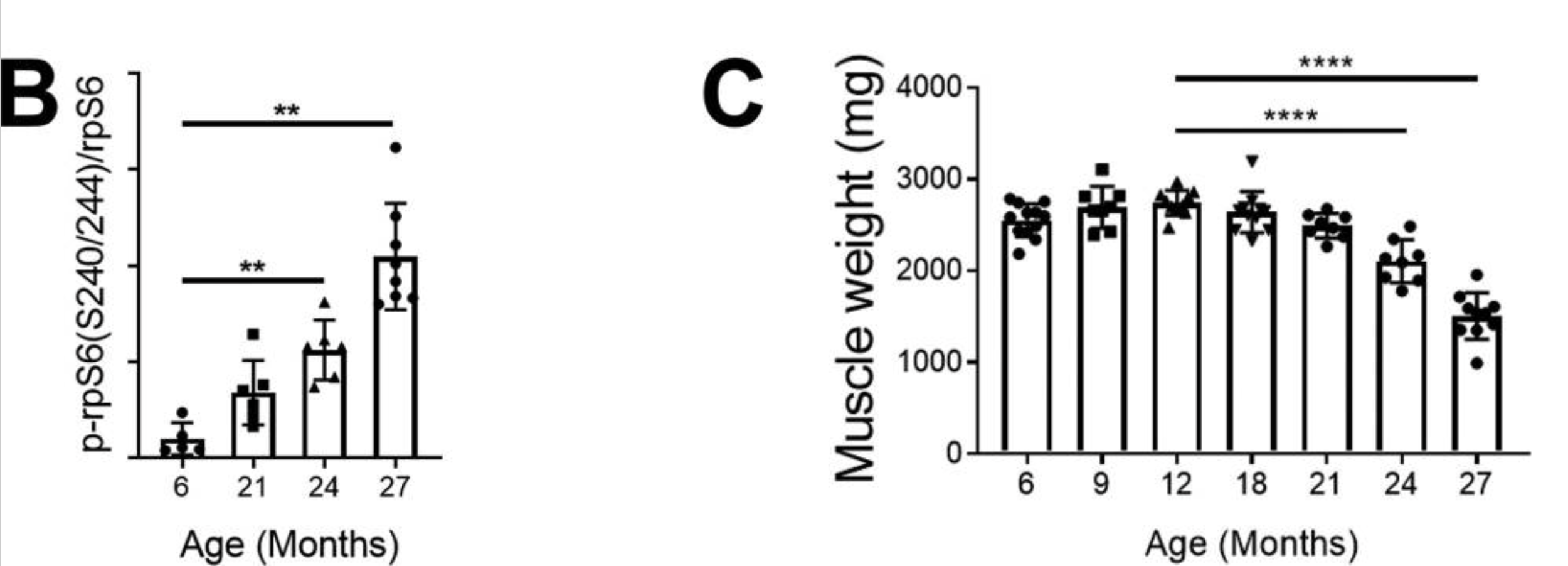
Figure 2: In aging muscle, mTOR signalling rises as muscle mass falls. In rats, the activity of mTORC1 (measured by phosphorylated rpS6) climbed roughly tenfold from youth to old age, while muscle mass progressively declined over the same period, the opposite of what the "mTOR builds muscle" intuition predicts.
Then came the counterintuitive test. The researchers treated 22-month-old rats for six weeks with a rapalog, a rapamycin analog called RAD001 (everolimus, a drug used in human medicine), at two doses: a low dose and a high, near-fully-inhibiting dose. The low dose was chosen to be clinically relevant, roughly equivalent to a 0.5-milligram dose in humans, the kind of low, intermittent rapalog dose that had already been shown to rejuvenate the aging immune system in people. And the results split sharply by dose. The high dose, which nearly shut mTORC1 off, did nothing for muscle mass. The low dose, which only partially inhibited the overactive pathway, was protective, and in some muscles restorative.
The muscle-mass results were specific rather than blanket, and worth stating precisely. Low-dose RAD001 did not cause further atrophy in any muscle, reassuring on its own, given the fear that inhibiting mTOR would shrink muscle. Beyond that, it significantly increased the mass of the tibialis anterior, modestly increased the plantaris, and left the gastrocnemius unchanged. Partial mTOR inhibition preserved or grew muscle in the muscles that responded, and harmed none. Under the microscope, the improvement was visible: in the responsive muscle, the proportion of tiny, misshapen, atrophic fibers fell by about half, and the fraction of fibers with central nuclei, a telltale sign of muscle caught in cycles of degeneration and repair, dropped from roughly 23 percent to about half that. The tissue looked younger.
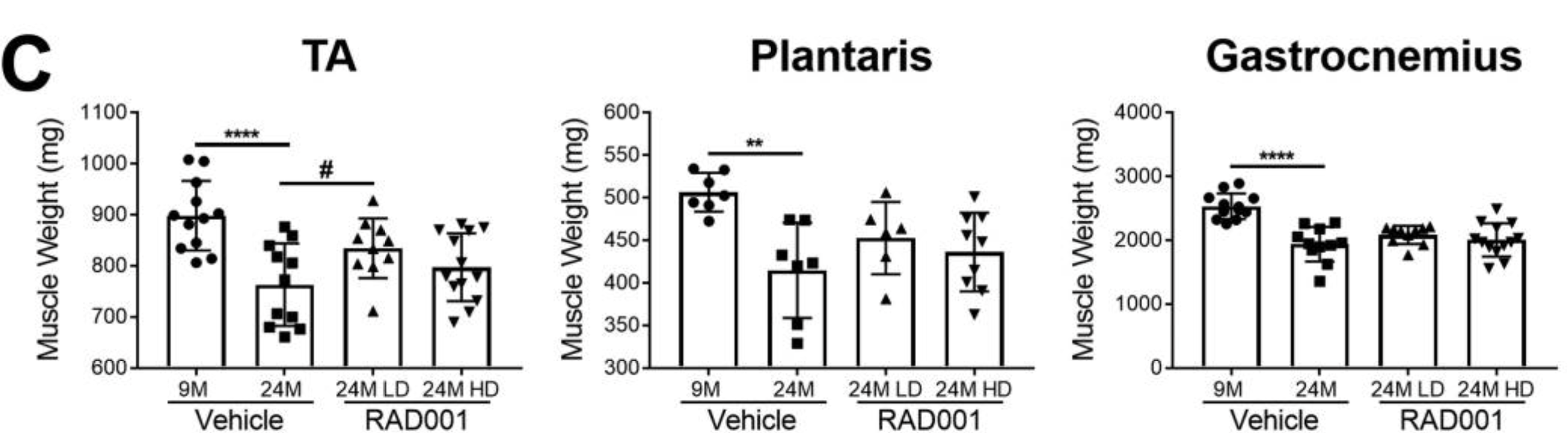
Figure 3: A low, partial dose preserved or grew muscle; a high dose did not. Muscle weights in young rats, aged untreated rats, and aged rats given low- or high-dose RAD001. Low-dose partial mTOR inhibition increased tibialis anterior mass and modestly raised plantaris, without shrinking any muscle; the near-fully-inhibiting high dose showed no benefit.
The molecular changes underneath explained how. Aging muscle, left untreated, ran high in the machinery of breakdown and distress: the atrophy-promoting enzyme MuRF1, stress proteins called metallothioneins, and the cellular-senescence markers p16 and p21, all elevated with age. In the responsive muscle, low-dose RAD001 pushed several of these back down, reducing MuRF1, lowering a metallothionein, and returning the senescence markers toward youthful levels. It also quieted molecular markers of denervation, the fraying of nerve-to-muscle connections that drives much age-related muscle loss.
And there was a second, elegant half to the mechanism. Partially inhibiting mTORC1 did not only quiet the overactive anabolic pathway; in the muscles that benefited, it also switched on a cleanup pathway, raising the activity of the energy sensor AMPK and restoring autophagy, the cell's system for clearing out damaged components, which declines with age. Tellingly, only the muscles that restored autophagy gained mass. The paper's synthesis is worth stating in full, because it is more sophisticated than "inhibit mTOR": the benefit seems to require a balance, dialing down the chronically overactive building pathway just enough while simultaneously reviving the catabolic housekeeping that keeps muscle healthy. Too much inhibition, the high dose, disrupts that balance and the benefit disappears. We have covered this study in more detail elsewhere; what matters here is how cleanly it converges with the modelling paper.
The benefit seems to require a balance, dialing down the chronically overactive building pathway just enough while simultaneously reviving the catabolic housekeeping that keeps muscle healthy.
Put the two together and the paradox resolves. Aging muscle runs its growth signalling chronically high at rest, and both studies see it: the model as a compensation that props up baseline synthesis, the Glass lab as a hyperactivation that coincides with wasting. These are not conflicting pictures; they are the same phenomenon through different instruments. And the rapamycin work adds the therapeutic turn: if the chronically elevated resting signal is part of what limits aging muscle, then carefully, partially quieting it, while restoring the cell's cleanup systems, may let the muscle behave more like young muscle again. The goal is not to suppress muscle building but to restore the muscle's ability to swing properly between a quiet resting state and a strong fed one. Quiet the idle, and you may recover the surge.
The caveats here are essential, not incidental. These findings are in rats, and rat muscle aging is not identical to ours. The benefit was strikingly dose-dependent and muscle-specific: only the low, partial dose helped, only some muscles responded, and the paper is explicit that mTOR inhibition alone was not sufficient to maintain muscle mass across the board, since one improved muscle showed mass gains without the expected molecular changes. This is emphatically not a basis for taking rapamycin or a rapalog to build muscle on one's own, and anyone using or considering these drugs should do so only under medical supervision. What the convergence offers is not a protocol but a reframing: that in aging muscle, as in much of aging biology, the problem may be not too little mTOR signalling but too much of it, chronically, in the wrong state, and that the counterintuitive fix is to turn it down, carefully and partially, so it can rise properly when it should.
No Single Fix
Having used the model to take anabolic resistance apart, the researchers turned it toward the question that matters for treatment: what would it take to put muscle building back together? If you could reach into the system and repair one broken mechanism, restore it to its youthful value, would the muscle respond to protein again?
The model let them test this directly, and cleanly, in a way no clinical trial could. They could take a virtual older muscle with its mechanisms impaired, then "treat" it by returning one parameter, mTORC1 sensitivity, say, or the level of mTOR protein, to the healthy value, and read out whether muscle protein synthesis recovered. It is a simulation of the logic behind most drug development: find the broken thing, fix it, restore function.
When only one mechanism was impaired, single fixes worked well. If reduced mTORC1 sensitivity was the lone problem, restoring mTORC1 sensitivity recovered the response. If the only issue was low p70S6K, raising it back up largely did the job. In a muscle with a single point of failure, targeting that point is enough. This is the world that one-drug-one-target development implicitly assumes.
But that is not the world an aging muscle actually inhabits. The whole thrust of the study is that in a real older adult, the mechanisms are impaired together, not one at a time. So the researchers simulated the realistic case: all the mechanisms dysregulated simultaneously, as they presumably are in aging muscle, and then tried each single fix against that combined dysfunction.
No single fix worked. When every mechanism was impaired at once, restoring any one of them, mTORC1 sensitivity, mTOR levels, p70S6K levels, splanchnic extraction, failed to bring muscle protein synthesis back to healthy levels. Each intervention helped a little, correcting its own piece, but left the others untouched, and the muscle's response remained blunted. The single lever, so effective against a single problem, was overwhelmed by a multifactorial one.
What did work was combination. When the researchers restored several mechanisms together, the model identified specific combinations that brought muscle protein synthesis back toward its healthy target of roughly 0.47 grams of leucine, and net balance back to healthy levels alongside it. The successful strategies shared a clear pattern: they restored the levels of the signalling proteins, mTOR and p70S6K, rather than only tweaking their activity, and they hit both ends of the pathway at once, reducing the gut's amino acid theft upstream while restoring the muscle's signalling machinery downstream. One near-complete recovery came from restoring splanchnic extraction, mTORC1 sensitivity, and both mTOR and p70S6K levels together. And the requirement scaled with the damage: the more mechanisms that were broken at once, the more targets a successful intervention had to hit simultaneously to bring the muscle back. Only a coordinated, multi-target intervention could overcome a multi-mechanism disease.
This is the study's central practical message, and it explains something that has frustrated the field for years. Interventions for sarcopenia and anabolic resistance have a long history of disappointing results in the long run, single supplements, single drugs, single targets that showed early promise and then underdelivered. The model offers a clean explanation: they were single fixes aimed at a multifactorial problem. A therapy that corrects one mechanism will always fall short if several others remain impaired. The path to restoring aging muscle's response to protein, the model suggests, runs through hitting multiple mechanisms at once, because there is no one magic lever to find. And it points, interestingly, to a particular emphasis: restoring the amount of the core signalling proteins, not merely their activity, since several of them decline substantially with age, and boosting the activity of what little remains may not be enough when the underlying quantity has fallen.
What a Model Can and Can't Tell You
The strength of this work is also the source of its central limitation: the main study is a model. Every one of its findings is a prediction of what should happen given the biology and data built into the simulation, not a measurement of what did happen in a person. That distinction governs how all of it should be read.
The predictions are only as good as their inputs. The model was assembled from published human data, and where that data is sparse or uncertain, the model inherits the uncertainty. The fold-changes used to represent each mechanism, how much splanchnic extraction rises with age, how much mTOR sensitivity falls, were drawn from a handful of studies, in some cases only two or three, and the researchers had to distinguish a consensus estimate from a worst-case one precisely because the underlying measurements vary. The model integrates the best available numbers, but it cannot be more certain than the measurements beneath it. Its conclusions are hypotheses for experiments to test, not results that close the question.
The model was built on data from men. The human studies that calibrated it and defined its mechanisms, including the anchor comparison of younger and older adults, used male subjects. Muscle protein metabolism and its age-related changes can differ between the sexes, and whether these findings hold in women is genuinely unknown and needs direct study. This matters, because women are at least as affected by sarcopenia as men.
The model simulated a purified amino acid drink, not a meal. The anchor experiments and the simulations used a dose of essential amino acids in solution, which is a clean stimulus but not how people eat. Real food arrives with fat, carbohydrate, fiber, and a slower, more complex digestion and insulin response, and the researchers note that with actual meals, some of the impairments could behave differently, and in some respects worse, than the model predicts. The model illuminates the response to a controlled bolus, not the full complexity of eating dinner.
The model also assumed muscle breakdown stays relatively stable with age. This is a defensible assumption, since increased breakdown has not been consistently observed in healthy aging, and the study tested a version with elevated breakdown and found it changed net balance more than synthesis. But if breakdown does rise meaningfully in some older adults, through chronic inflammation, for instance, the real net loss would be larger than these simulations show.
The therapeutic combinations are leverage points, not prescriptions. The model identifies which mechanisms, restored together, would recover muscle building. It says nothing about whether those mechanisms can actually be drugged safely in humans, and the researchers are explicit that raising the levels of specific signalling proteins in muscle is not something any current therapy does. The model tells you where to aim; it does not hand you a treatment.
The rapamycin thread carries its own, separate limitations, and they are worth restating because that evidence comes from a different study of a different kind. The Glass lab findings are in rats, not humans. The benefit was strikingly dependent on a low, partial dose and appeared in some muscles but not others, and the authors themselves concluded that mTOR inhibition alone was not sufficient to maintain muscle mass across the board. That work also came from a pharmaceutical company that makes the drug it tested. The convergence between the two papers, on the idea that aging muscle runs its growth signalling chronically high and that carefully lowering it may help, is real and striking, but it is an alignment of a rat drug study with a human-calibrated model, not a demonstration in living people that this approach restores muscle.
None of this diminishes what the modelling study accomplishes. It reframes anabolic resistance as multifactorial, explains why single treatments have disappointed, and generates specific, testable hypotheses about which mechanisms matter most and which combinations might work. But it is a map of what the current evidence implies, drawn to guide the next experiments, not a finished account of what is happening in any individual person's muscle, and certainly not, on its own, a license to act.
What This Means, Including What You Can Do
The model's conclusions run in two directions: one for the researchers who will chase the mechanisms, and one, more immediately useful, for anyone who wants to protect their own muscle as they age.
For the science, the study redraws the map. It says that anabolic resistance is multifactorial, that the mTORC1 signalling hub and its sensitivity are the highest-value targets, that the amount of the core signalling proteins matters as much as their activity, and, most consequentially, that effective treatment will require hitting several mechanisms at once. It also surfaces, and the rapamycin work reinforces, the genuinely counterintuitive possibility that part of the problem is chronically elevated signalling at rest, and that carefully quieting it could help restore the muscle's response. These are directions for research, and valuable ones, because they redirect effort away from the single-target thinking the model suggests is destined to underperform.
Here is the part that matters for a reader today, and it is the study's most grounded implication even though the paper states it almost in passing. The multi-target intervention that anabolic resistance demands is not some future drug combination. A version of it already exists, and it is available to nearly everyone, right now. It is the combination of sufficient protein and resistance exercise.
Consider how those two act on the very mechanisms the model implicates. The problem is a signalling hub that has grown less sensitive to leucine, less machinery, a compressed response to feeding. Resistance exercise addresses the core defect directly: a large body of evidence shows that physical activity, and resistance training in particular, re-sensitizes aging muscle to the anabolic signal that protein provides. A trained muscle responds to a meal more like a young one. That is not a supplement nudging a single downstream parameter; it is an intervention working upstream on the central mechanism the model identified as dominant. And protein addresses the input side. If the signalling hub is less sensitive and the gut is skimming more amino acids, one direct countermeasure is to deliver more of the signal, more total protein, and particularly more leucine, distributed across the day so each meal clears the threshold needed to drive synthesis. Protein and resistance exercise are not two separate tactics; they are complementary, one restoring the muscle's sensitivity, the other supplying more of what it responds to. Together they hit several of the model's mechanisms at once, which is exactly what it says a multifactorial problem requires.
This is why the grounded advice and the sophisticated model converge. The most powerful multi-target intervention available today is not pharmacological. It is enough high-quality protein, spread across the day, plus consistent resistance training, and the reason it works is precisely that it does what a single pill cannot, hitting the sensitivity of the hub and the availability of the signal together.
The pharmacological frontier is real, and this is where the rapamycin thread earns its place, but it has to be held at the right altitude. The convergence of the modelling study and the Glass lab work makes a genuinely interesting case that the chronic overactivation of mTOR at rest is part of what ails aging muscle, and that carefully, partially inhibiting it, at a low dose, in the right context, might help restore the muscle's dynamic response. Rapamycin and its analogs are among the most closely watched compounds in longevity medicine for exactly this kind of reason, their ability to modulate a master aging pathway. With that being said, everything about the muscle evidence points to how much the details matter: the dose that helped aging rats was low and partial, not high; the effect was muscle-specific; and too much inhibition erased the benefit. This is not a molecule to experiment with on one's own. It is a prescription medication whose use for longevity is still being worked out, and whose narrow therapeutic window is exactly the kind of thing that calls for medical oversight, careful dosing, and monitoring rather than guesswork. For anyone drawn to that frontier, the responsible path is a clinician-guided one. Healthspan's Rapamycin Protocol exists for precisely that reason: to make rapamycin's longevity potential accessible under medical supervision, with the dosing and monitoring that a drug this nuanced demands, rather than left to trial and error.
There is one more thing worth taking from all this, and it is about timing. The impairments the model describes accumulate slowly, over decades, each one small before it compounds with the others. Which means the trajectory of your muscle in your seventies and eighties is being set, in part, by what you do in your forties and fifties, whether you keep the signalling pathways exercised and well-fed, or let them drift toward the multifactorial failure that is so hard to reverse once it has fully arrived. Anabolic resistance is not a switch that flips in old age. It is a slope, and the best time to start managing it is well before it becomes visible.
Conclusion: Several Small Failures, One Hard Problem
The picture this study leaves you with is the muscle that stops listening, and a clearer understanding of why. Aging muscle does not fail to answer protein because of one broken part that might someday be replaced. It fails because several parts each falter a little, the gut takes more, the machinery thins, the hub grows less sensitive, and their modest deficits compound into a response too weak to hold muscle in place. And in a final twist, the muscle's own attempt to compensate, by running its growth signalling chronically high at rest, both helps hold the line and, quite possibly, leaves less room to surge when a meal arrives. Anabolic resistance is not a single lesion. It is a system drifting out of tune on several strings at once.
That is a discouraging picture for anyone hoping science will deliver a single pill for muscle aging, and the model is honest about why that hope is misplaced. A single fix aimed at a multifactorial problem keeps falling short, no matter how well it corrects its one target. The long history of disappointing sarcopenia treatments starts to look less like bad luck and more like the predictable result of single-target thinking applied to a problem that was never single-target.
But the same finding that dims the hope for a magic pill brightens the case for what already works. If aging muscle needs several mechanisms addressed at once, then the interventions that matter are the ones that act broadly, and two of them are available to almost everyone, today. Resistance exercise restores the muscle's sensitivity to protein at the level of the signalling hub itself. Adequate, leucine-rich protein, spread across the day, supplies more of the signal. Together they do, through biology we have understood for a long time, what the model says a treatment for anabolic resistance must do: hit several mechanisms simultaneously. The sophisticated systems model and the timeworn advice arrive at the same place.
And at the frontier, the same logic that governs the muscle governs the most interesting drug in the conversation. If part of what ails aging muscle is a growth pathway stuck chronically on, then the counterintuitive move, carefully turning it down so it can rise properly when fed, is exactly what the convergence of the modelling study and the rapamycin work suggests. That possibility is real, and it is worth pursuing, with the care and medical oversight a nuanced drug demands. However, its deepest lesson only reinforces the grounded one: aging muscle is not failing for want of more signalling. It is failing for want of the right signalling, in the right amount, at the right time. The muscle you carry decades from now depends less on finding a single perfect countermeasure than on keeping the whole system in tune, and the surest way to do that, starting long before the decline announces itself, is still to eat well and to make your muscles work.
Related studies