Low-Dose Naltrexone: Is 4.5 mg Really the Limit?
4.5 mg is a benchmark, not a ceiling. Early studies helped establish 4.5 mg as the familiar reference dose, but emerging evidence suggests effective LDN dosing may extend both below and above this range.
LDN response is highly individualized. Some individuals respond best at ultra-low doses around 0.5–1.5 mg, while others may require gradual titration toward 6–9 mg before meaningful benefit emerges.
Biology shapes the “sweet spot.” Differences in inflammatory burden, microglial activity, opioid tone, receptor sensitivity, and stress history may all influence the dose that works best.
Formulation and timing matter too. Capsules, sublingual preparations, morning dosing, and evening dosing may produce different tolerability and response patterns.
LDN may support more than symptom relief. Its effects on neuroimmune regulation, inflammatory signaling, recovery, and resilience have placed it within the broader discussion of healthy aging and gerotherapeutics.
The Healthspan approach emphasizes guided optimization. The goal is not to reach a fixed dose, but to identify the range where benefit, tolerability, and physiological resilience are best aligned.
Introduction: The LDN Renaissance
For decades, naltrexone occupied a relatively narrow role in medicine. At doses of 50–100 mg, it was primarily prescribed for alcohol and opioid use disorders, functioning as an opioid receptor antagonist that reduced the effects of exogenous opioids. What few anticipated was that naltrexone would behave very differently at much lower doses.
Over the past two decades, researchers and clinicians have increasingly explored low-dose naltrexone (LDN), a therapeutic and geroprotective approach that appears to influence neuroimmune communication, inflammatory signaling, endogenous opioid production, and cellular stress responses in ways that differ fundamentally from its traditional use [1,2]. A recent comprehensive review highlighted the expanding evidence base supporting LDN's immunomodulatory and anti-inflammatory effects, along with its favorable safety profile across diverse clinical settings [1].
As interest in LDN has grown, so has an important practical question: how much is actually needed to produce a meaningful biological effect?
In both clinical practice and the published literature, 4.5 mg has gradually become regarded as the conventional upper end of the "low-dose" range. Yet observational data and real-world experience suggest the therapeutic window may be considerably broader. Some individuals appear to respond at doses as low as 0.5–1.5 mg, while others may require 6–9 mg before meaningful benefit is observed [1-3].
From a Healthspan perspective, LDN may be better understood not as a fixed protocol, but as a tool for guided optimization. The goal is not necessarily to reach a universal target dose, but to identify the range in which an individual's neuroimmune and inflammatory systems respond most favorably.
This article explores the evidence behind that shift and examines why, for some individuals, lower doses may provide the clearest biological response, while for others a higher low dose may ultimately prove more effective.
The 4.5mg Dogma: A Historical Benchmark, Not a Biological Ceiling
In pharmacology, certain doses become standard not because they are biologically optimal, but because they are the first to be studied consistently. The 4.5 mg LDN dose appears to be one of those examples.
As described by Leiber et al. 2025, the widespread adoption of 4.5 mg as the standard low dose of naltrexone reflects historical precedent more than definitive dose-response evidence [4]. In early clinical trials, including studies of Crohn’s disease and multiple sclerosis, 4.5 mg was commonly selected as a practical titration endpoint [5,6]. Because some of these studies demonstrated benefit, 4.5 mg became the dose most frequently published, repeated, and incorporated into clinical practice.
However, familiarity is not the same as biological precision. Treating 4.5 mg as a fixed ceiling assumes that therapeutic benefit reliably peaks at that point. The broader literature suggests a more variable response pattern. Across conditions, effective dosing has been reported both below and above 4.5 mg, indicating that this value may be better understood as a midpoint within a wider and still incompletely characterized therapeutic window.
This distinction has practical implications. If titration routinely stops at 4.5 mg simply because it is the most recognized dose, some individuals may remain underdosed. Others, particularly those with greater sensitivity, may respond more favorably at substantially lower doses.
This variability is mechanistically plausible. LDN does not act on a single linear pathway. It interacts with interconnected opioid, immune, and neuroinflammatory systems that differ considerably between individuals. Factors likely influencing response include microglial activity, endogenous opioid tone, genetics, lifestyle, and inflammatory history. Someone with longstanding systemic inflammaging, for example, may respond differently from a younger individual using LDN for preventative or performance-focused purposes.
Marcus et al. (2024) support this individualized framework, showing that maximally effective dosing appears highly variable between patients [3]. In their observational data, meaningful benefit emerged for some individuals near 1.5 mg, while others appeared to require 6–9 mg before sufficient receptor engagement and clinical improvement occurred.
The broader review by Leiber et al. reinforces this point (Table 1). Across the available literature, 62 studies reported at least some degree of efficacy in one or more participants using LDN as treatment [4]. Reported benefits ranged from mild symptom or pain relief to complete symptom clearance or disease remission [4]. This wide clinical landscape does not identify one universal dose, but instead highlights the need for individualized titration.
Table 1. The Expanding Clinical Landscape of LDN Utility
- Chronic pain (relating to various conditions): 8 published studies
- Fibromyalgia: 8 published studies
- Hailey-Hailey disorder: 6 published studies
- Multiple sclerosis: 5 published studies
- Crohn's disease: 4 published studies
- Post-acute sequelae of COVID-19: 3 published studies
- Inflammatory bowel disease: 3 published studies
- Psoriasis: 3 published studies
- Chronic fatigue syndrome: 2 published studies
- Arthritic conditions: 2 published studies
- Chronic regional pain syndrome: 2 published studies
- Darier disease: 2 published studies
- Lichen planopilaris: 2 published studies
- Amyotrophic lateral sclerosis: 1 published study
- Ulcerative colitis: 1 published study
- Mesenteric panniculitis: 1 published study
- Gadolinium deposition disease: 1 published study
- Neuropathic corneal pain: 1 published study
- Systemic sclerosis: 1 published study
- Amyopathic dermatomyositis: 1 published study
- Major depressive disorder: 1 published study
- Non-small cell lung cancer: 1 published study
- High-grade gliomas: 1 published study
- Various gastrointestinal disorders: 1 published study
- Burning mouth syndrome: 1 published study
- Painful diabetic neuropathy: 1 published study
- Postural orthostatic tachycardia syndrome: 1 published study
- Prurigo and acne excoriee: 1 published study
- Excoriation disorder: 1 published study
- Stiff-person syndrome: 1 published study
- Sjogren’s syndrome: 1 published study
Adapted from Leiber et al. (2025), documenting the diversity of conditions currently under investigation.
Why the LDN "Sweet Spot" Varies
The variability in LDN response becomes especially apparent when examining real-world dosing data.
In the 2024 observational study by Marcus et al., investigators evaluated chronic pain populations and found that effective dosing was distributed across a much broader range than the conventional 4.5 mg benchmark [3]. While many individuals responded between 3 and 4.5 mg, others required doses of 6–9 mg before meaningful clinical improvement was observed.
These findings challenge the assumption that 4.5 mg represents a universal therapeutic endpoint. Instead, they suggest that apparent "non-response" may sometimes reflect incomplete dose optimization rather than a lack of biological activity.
Healthspan community observations appear to reflect a similar pattern. Although 4.5 mg works well for many individuals, meaningful responses have been observed across a range extending from approximately 0.5 mg to 9 mg. This variability likely reflects differences in inflammatory burden, neuroimmune activation, receptor sensitivity, oxidative stress, and overall physiological resilience.
Mechanistically, this diversity of response is not surprising. LDN appears to influence multiple interconnected systems, including endogenous opioid signaling, microglial activity, immune regulation, and cellular stress-response pathways [1,4]. Rather than acting through a single linear mechanism, LDN functions within a dynamic biological network where the optimal stimulus may vary substantially from one individual to another.
This framework aligns with the concept of hormesis, where a modest biological stressor triggers beneficial adaptive responses. For some individuals, a relatively small dose may provide the ideal signal. For others, a stronger stimulus may be required before meaningful neuroimmune or inflammatory regulation occurs. More is not necessarily better, but neither is less.
Seen through this lens, the goal becomes less about identifying a universal "correct" dose and more about discovering the range in which an individual's neuroimmune and adaptive signaling systems respond most favorably.
Pharmacokinetics and Mode of Delivery: Does Formulation Matter?
Discussions surrounding LDN often focus on dose, yet formulation may also influence therapeutic response. While most studies have utilized standard oral capsules or tablets, compounded preparations now include liquid formulations, sublingual drops, and troches. Although comparative pharmacokinetic research remains limited, these delivery methods may produce different absorption patterns that influence tolerability and individual response.
Traditional oral capsules are absorbed through the gastrointestinal tract and undergo first-pass metabolism before entering systemic circulation. This route remains the most widely prescribed form of LDN and has been used in the majority of published studies. For many individuals, oral capsules provide predictable exposure and are sufficient to achieve therapeutic benefit. However, gastrointestinal absorption can vary based on digestive health, meal timing, concurrent medications, and individual metabolic differences.
Sublingual formulations, including LDN troches, attempt to bypass part of this process by allowing absorption through the oral mucosa. According to the LDN Research Trust, sublingual administration may provide more rapid systemic exposure while reducing some of the variability associated with gastrointestinal absorption [9]. This approach may be particularly useful for individuals with digestive disorders, malabsorption concerns, or sensitivity to capsule excipients. It may also facilitate more gradual dose adjustments when searching for an individual's optimal therapeutic range.
From a practical standpoint, formulation should be viewed as another variable that can be personalized. Some individuals achieve excellent results with conventional capsules, while others report improved tolerability or response when switching to a sublingual preparation. Because LDN appears to operate within a highly individualized neuroimmune network, optimizing delivery method may be just as important as optimizing dose.
At present, direct comparisons between oral and sublingual LDN remain limited. As a result, formulation decisions are typically guided by patient preference, tolerability, clinical experience, and observed response rather than definitive pharmacokinetic evidence.
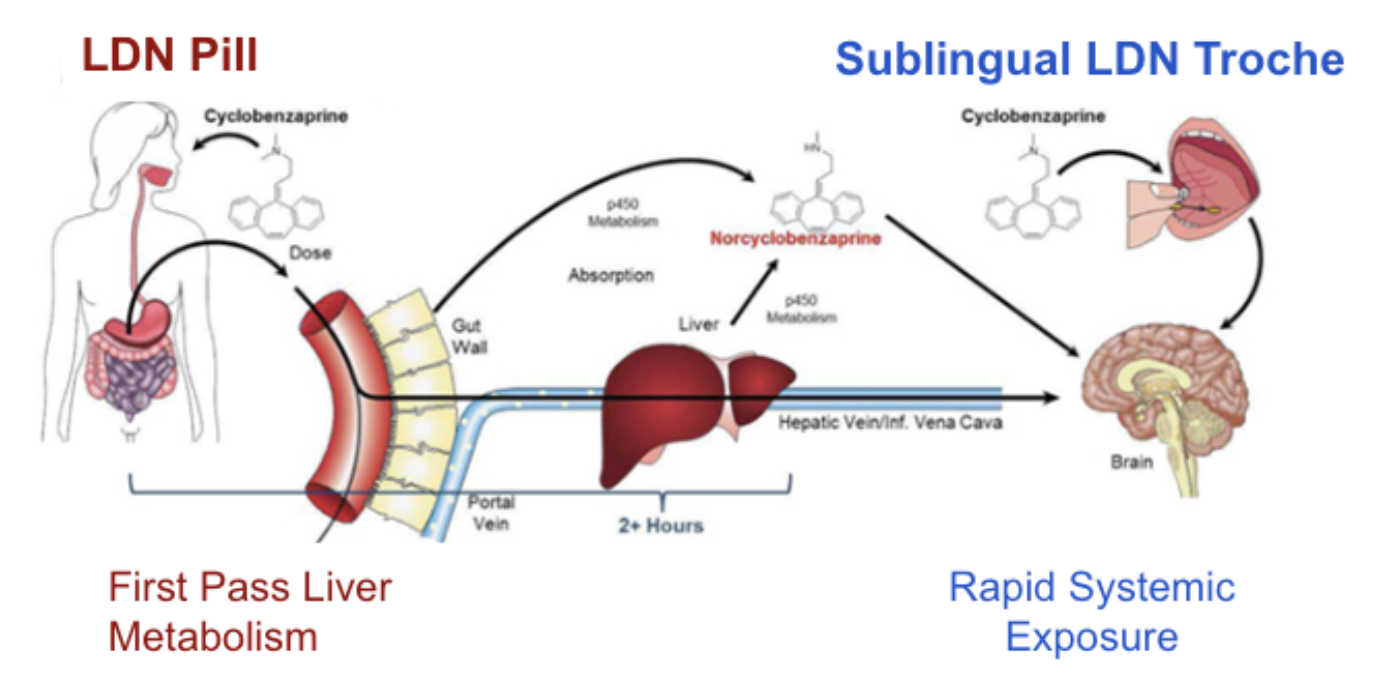
Figure 1 - LDN Mode of Delivery Diagram. Visual depiction of absorption and metabolism of LDN as a pill swallowed or sublingual troche. The pill relies upon first pass liver metabolism and is absorbed more slowly. The LDN troche is more rapidly absorbed avoiding first pass liver metabolism. Adapted from Low Dose Naltrexone Research Trust. New Formulation LDN Sublingual Drops.
Timing of Administration: Morning vs Evening Dosing
Another variable that often receives less attention than dose is timing. Historically, LDN has most commonly been administered in the evening, based on the hypothesis that temporary opioid receptor blockade during the night may coincide with endogenous endorphin rhythms and maximize the subsequent rebound response.
While this remains a common clinical practice, growing real-world experience suggests that timing may be highly individualized. Some individuals experience vivid dreams, sleep disruption, or insomnia when taking LDN before bed [1]. In these cases, shifting administration to the morning often improves tolerability without necessarily diminishing therapeutic benefit.
This observation is consistent with the broader theme emerging throughout the LDN literature. The optimal protocol may depend less on adhering to a universal standard and more on identifying the combination of dose, timing, and formulation that produces the most favorable biological response for a given individual.
For most individuals beginning therapy, evening administration remains a reasonable starting point. However, persistent sleep-related side effects should not automatically be interpreted as treatment failure. In many cases, a simple adjustment in dosing time may substantially improve the overall experience while preserving clinical benefit.
Low-Dose Sensitivity: When Less Is Actually More
Although 4.5 mg is often treated as the standard reference point, clinical experience frequently identifies a subset of individuals who appear to respond best at substantially lower doses, often between 0.5 mg and 1.5 mg [1].
These ultra-low-dose responders highlight an important principle of LDN therapy: response appears to depend less on the absolute dose and more on how an individual's physiology adapts to transient opioid receptor blockade. For some individuals, a relatively small stimulus may be sufficient to trigger the desired biological response, while larger doses may offer little additional benefit.
The most widely discussed explanation involves the opioid rebound effect. Naltrexone temporarily blocks opioid receptors, and in response the body appears to compensate by increasing endogenous opioid production, including endorphins, while also upregulating related receptors. This rebound response is thought to contribute to many of LDN's proposed immunomodulatory and neuroregulatory effects. Importantly, the therapeutic goal may not be maximal receptor blockade, but rather an appropriate duration of blockade that allows compensatory signaling to occur.
For individuals who are particularly sensitive to this mechanism, higher doses may extend receptor blockade beyond the optimal window. Clinically, this may present as vivid dreams, insomnia, irritability, or a generalized reduction in perceived benefit. In these cases, reducing the dose can sometimes improve both tolerability and effectiveness.
This pattern is consistent with the broader biological concept of hormesis, in which a modest stressor triggers beneficial adaptive responses. For some individuals, doses near 0.5–1.5 mg may provide a sufficient signal to promote endorphin upregulation and engage adaptive pathways associated with cellular resilience [1,2]. More is not necessarily better; the optimal response may occur at the lowest dose capable of producing meaningful physiological adaptation.
At the same time, ultra-low-dose responsiveness represents only one end of the therapeutic spectrum. Other individuals appear to require substantially greater signaling engagement before meaningful clinical effects emerge.
The Case for Higher Dosing: Crossing the Threshold
At the opposite end of the spectrum are individuals who appear to require higher low doses, typically between 6 mg and 9 mg. For these individuals, 4.5 mg may not represent excessive blockade, but rather insufficient neuroimmune and receptor-level modulation.
Marcus et al. (2024) provide important support for this threshold-based model [3]. In their observational study, meaningful functional improvement often emerged only after participants exceeded the conventional 4.5 mg range. These findings suggest that for some individuals, the biological signal generated by lower doses may simply be insufficient to produce a clinically meaningful response.
One possible explanation involves the neuroimmune systems that LDN appears to influence. Beyond its effects on opioid receptors, LDN has been proposed to modulate Toll-Like Receptor 4 (TLR4), a receptor expressed on microglia, the resident immune cells of the central nervous system [4]. When chronically activated, microglia can promote a pro-inflammatory state characterized by increased cytokine signaling and heightened pain sensitivity. This process has been implicated in chronic pain, neuroinflammation, fatigue syndromes, and other conditions associated with persistent immune activation.
Under these circumstances, a greater degree of signaling engagement may be required before meaningful physiological change occurs. Individuals with longstanding chronic pain, prior infection, elevated inflammatory burden, or age-related inflammaging may begin from a different biological baseline than younger or metabolically healthier individuals. For some, gradual titration toward 6–9 mg may provide a stronger therapeutic signal capable of influencing these pathways.
This may be particularly relevant for partial responders, individuals who notice modest improvements in pain, energy, recovery, or overall function at 4.5 mg but continue to experience persistent symptoms. In these cases, cautious dose escalation may help determine whether additional benefit can be achieved before concluding that therapy has plateaued.
Viewed through this lens, some apparent "LDN non-responders" may instead represent individuals whose therapeutic threshold has not yet been reached. The challenge is not necessarily finding the highest tolerated dose, but identifying the dose at which meaningful biological adaptation begins to occur.
Assessing Response: Beyond Dose Alone
One of the challenges with LDN is that therapeutic response can be gradual, subtle, and multifactorial. Unlike medications that produce an immediate and obvious effect, LDN may influence neuroimmune regulation, inflammatory signaling, resilience, and recovery over weeks or months. As a result, some individuals may conclude too early that the therapy is not working, when they may simply be looking for the wrong signals.
Successful LDN use is often associated with improvements in energy, recovery, pain sensitivity, sleep quality, stress resilience, and overall quality of life [7]. These benefits do not always emerge at the same time. One person may first notice deeper sleep or improved morning energy, while another may experience better recovery after exertion before pain or inflammation meaningfully changes.
Objective metrics can help provide additional context. Depending on the clinical situation, clinicians may monitor hs-CRP, fasting insulin, glucose regulation, autoimmune markers, or other indicators of inflammatory burden [8]. Wearable-derived metrics, including heart rate variability, resting heart rate, sleep efficiency, and recovery scores, may also help capture subtle shifts in autonomic regulation and physiological adaptation over time.
From a Healthspan perspective, the goal is not simply to identify the highest tolerated dose. The more useful objective is to find the combination of dose, timing, and formulation that produces the greatest improvement in physiological resilience while maintaining excellent tolerability. This process often requires patience, structured observation, and periodic reassessment.
Viewed this way, LDN becomes less of a fixed protocol and more of a personalized optimization strategy. The most successful long-term users are often those who approach therapy iteratively, allowing clinical response and physiological feedback to guide decision-making rather than relying solely on predetermined dosing conventions.
The Healthspan Perspective: LDN as a Personalized Longevity Tool
Real-world data provide additional reasons for interest. In a 2024 retrospective study involving more than 3,500 participants, 69.2% of users reported significant improvements in quality-of-life measures, including energy and physical function. Investigators also observed a 24.6% mean improvement in immune function scores after three months of use [7].
Importantly, the next phase of research is already underway. Several active clinical trials are evaluating LDN across conditions characterized by neuroimmune dysfunction, autonomic imbalance, and impaired recovery. Trial NCT05363514 is investigating LDN in individuals with Postural Orthostatic Tachycardia Syndrome (POTS), a condition often associated with autonomic nervous system dysregulation and chronic symptom burden. Trial NCT07285473 is evaluating LDN in myalgic encephalomyelitis/chronic fatigue syndrome (ME/CFS), a disorder characterized by profound fatigue, impaired recovery, and emerging evidence of immune dysfunction.
Perhaps most intriguing from a Healthspan perspective is NCT07475546, a study examining multiple geroprotective strategies designed to influence biological aging and long-term health outcomes. LDN is included as one of the intervention variables being evaluated, reflecting growing interest in whether its effects on immune regulation, neuroinflammation, and physiological resilience may extend beyond symptom management and into the broader domain of healthy aging.
While none of these studies alone will determine LDN's ultimate role in longevity medicine, they represent an important evolution in the field. The conversation is increasingly shifting from disease-specific symptom reduction toward questions of resilience, recovery capacity, autonomic regulation, and the preservation of physiological function across the lifespan.
From a Healthspan perspective, this brings us back to the central theme of the article. The goal is not to identify a single "correct" dose, but to find the dose, timing, and formulation that best supports an individual's biology. In that sense, LDN is best viewed not as a fixed protocol, but as a personalized tool that may help optimize resilience, function, and long-term health.
- Gouda, A. H. K., Aitcheson, N. E. C., & Steadman, K. J. (2026). Low-Dose Naltrexone: What is the Evidence? A Narrative Review. Advances in therapy, 10.1007/s12325-026-03612-5.
- Li W, McIntyre RL, Schomakers BV, Kamble R, Luesink AHG, van Weeghel M, et al. Low-dose naltrexone extends healthspan and lifespan in C. elegans via SKN-1 activation. iScience 2024;27:109949. https://doi.org/10.1016/j.isci.2024.109949.
- Marcus NJ, Robbins L, Araki A, Gracely EJ, Theoharides TC. Effective Doses of Low-Dose Naltrexone for Chronic Pain – An Observational Study. J Pain Res 2024;17:1273–84. https://doi.org/10.2147/JPR.S451183.
- Leiber KK, Parker RW. Therapeutic Uses and Efficacy of Low-Dose Naltrexone: A Scoping Review. Cureus n.d.;17:e81086. https://doi.org/10.7759/cureus.81086.
- Paulides E, Lie MRKL, van der Woude CJ. Low-dose naltrexone for the induction of remission in patients with mild to moderate Crohn’s disease: protocol for the randomised, double-blinded, placebo-controlled, multicentre LDN Crohn study. BMJ Open 2022;12:e058358. https://doi.org/10.1136/bmjopen-2021-058358.
- Moloney BD, Forsyth A, Sumner RL, Glover SC, Hoeh NR, Sundram F, et al. Low-dose naltrexone as an adjunctive treatment for major depressive disorder: findings from a randomized, double-blind, placebo-controlled hybrid parallel-arm study. Front Pharmacol 2026;17. https://doi.org/10.3389/fphar.2026.1767654.
- AgelessRx. The Effects of Low Dose Naltrexone (LDN) on Diseases of Aging - A Retrospective Cross-sectional Study Into Off-label Use of LDN. clinicaltrials.gov; 2024.
- Harinath, G., Nyquist, A., Wouters, M., Isman, A., Verkennes, B., & Zalzala, S. (2024). Low-Dose Naltrexone as a Potential Healthspan-Enhancing Intervention in a Normative Aging Cohort: Changes in Quality of Life and Immune Health Metrics. Aging Biol, 2, e20240032.
- Low Dose Naltrexone Research Trust. New Formulation LDN Sublingual Drops. Available at: https://ldnresearchtrust.org/content/new-formulation-ldn-sublingual-drops
Related studies