Scientists Reversed Ovarian Aging in Mice by Blocking One Inflammatory Signal. The Same Signal Stiffens Organs Across the Body.
Prefer to listen? Hit play for a conversational, audio‑style summary of this article’s key points.
Aging tissues stiffen, and this study points to a single signal driving it. The heart, kidney, lung, arteries, and ovary all accumulate excess collagen scaffolding with age, hardening in ways that impair function. This stiffening has been treated as passive wear, but a new study in Nature Aging makes the case that it is an active, maintained process driven substantially by one inflammatory signal, interleukin-11 (IL-11), which means it may be reversible.
The ovary was the test case because stiffness there produces an unmistakable readout. The ovary ages faster than almost any organ, and its function depends acutely on the mechanical environment around its follicles. Dormant follicles need a stiff niche, growing ones need soft matrix to expand, and ovulation requires local softening. A uniformly stiffened ovary jams this system, which is why the researchers could show that stiffness alone, holding everything else constant, suppresses follicle growth and hormone production.
IL-11 rises with age in the ovaries of mice, rats, and humans alike. Working backward from the physical stiffening, the researchers traced it to IL-11, which activates the collagen-producing fibroblasts that harden the tissue. The cross-species conservation of this age-related rise, not previously reported, is one of the stronger signs that the finding reflects something fundamental rather than a quirk of one animal.
Deleting the IL-11 receptor protected aged ovaries, and the preserved eggs were genuinely good. Aged mice lacking the receptor kept softer tissue, more healthy follicles, higher estrogen and AMH, and greater ovulation. Critically, their eggs fertilized and developed into embryos at rates indistinguishable from controls, meaning the intervention preserved egg quality rather than simply producing more low-quality eggs.
The same mechanism drove stiffening across very different insults. Blocking IL-11 signaling mitigated ovarian stiffening not just in normal aging but in chemotherapy-induced ovarian failure and in a model of PCOS, where it also normalized the elevated testosterone that defines the condition. That three different insults converge on the same pathway suggests IL-11-driven stiffening is a common bottleneck through which many forms of ovarian damage act.
The headline result: an siRNA reversed stiffening in animals that had already aged. Rather than a genetic knockout present from birth, the researchers used a nanoparticle-delivered siRNA to silence IL-11 in middle-aged mice and rats with established stiffening. Ovarian stiffness dropped by roughly a third, follicle development recovered, and fertility improved, larger litters and higher pregnancy rates, from a drug given in adulthood. Reversing decline in an already-aged animal is categorically different from preventing it in an engineered one.
IL-11 is emerging as a systemic longevity target, not just an ovarian one. A landmark 2024 Nature study showed that inhibiting IL-11 extends both healthspan and lifespan in mice, and anti-IL-11 drugs are already in development for fibrosis of the heart, kidney, and lung. The ovarian result fits into that larger program: IL-11 appears to be a shared driver of the fibrosis and inflammation that degrade many organs with age, and anti-IL-11 antibodies are already in human trials for related conditions, which shortens the translational path.
IL-11 is not simply harmful, which is what makes the strategy plausible. Completely deleting IL-11 from birth causes infertility, because the signal does necessary developmental work. The problem in aging is not its presence but its chronic excess. Partial, adult-onset reduction, trimming the overexpression back toward youthful levels, is fundamentally different from lifelong elimination, and it is what the therapeutic approach targets. This mirrors mTOR, another signal that is essential in youth and damaging when chronically overactive in age.
The ovary may age on two connected fronts at once. A prior study Healthspan covered found reproductive aging driven from inside the egg by chronic mTOR signaling, which rapamycin can rebalance. This study adds a second driver operating outside the cell, in the stiffening matrix. The two are not fully independent, since IL-11 can itself activate mTOR downstream, and both converge on chronic fibroblast activation and failed cellular maintenance. Whether addressing both together preserves ovarian function better than either alone is an open and worthwhile question.
This is a preclinical result with a strong rationale, not a treatment. The reversal and restored fertility were in mice and rats; the human data is correlational. The delivery was systemic rather than ovary-targeted, the model tested prevention of ongoing decline rather than reversal of long-established disease, and long-term safety is unstudied. Nothing here is a reason to seek out IL-11-blocking drugs for aging or fertility. It is a reason for serious scientific interest and a genuinely promising direction, which is different from an answer.
Introduction: Aging Makes Tissues Stiff, and One Signal May Be Driving It
Reach into almost any aging organ and you will find the same physical change: it has become stiffer. The heart wall thickens and loses its give. Arteries harden. Kidney, lung, and liver tissue fill with dense, fibrous scaffolding where supple, working tissue used to be. We tend to treat this as scenery, the inevitable weathering of a body that has simply been running too long. This study is part of a growing case that we have it backwards. The stiffening is not the scenery of aging. It may be one of its engines.
The stiffening comes from the extracellular matrix, the mesh of collagen and structural proteins that surrounds every cell and gives tissue its physical character. Specialized cells called fibroblasts build and maintain this mesh. With age, fibroblasts turn overactive and lay down too much of it, cross-linked and rigid, and the tissue hardens. Here is the part that turns a passive process into an active one: cells constantly read the stiffness of their surroundings and change their behavior in response. So the hardening is not just an outcome. It becomes a signal, one that drives inflammation, dysfunction, and still more fibrosis, feeding forward on itself. Aging tissue, in this view, is not simply wearing out. It is actively holding itself in a stiffened, dysfunctional state.
If that is true, it raises a question with real stakes. A process that is actively maintained is a process that might be switched off. And a new study published in Nature Aging points to the switch: a single inflammatory signal called interleukin-11, or IL-11. The researchers show that IL-11 climbs with age in the ovaries of mice, rats, and humans alike, that it is what drives fibroblasts to stiffen the tissue, and, most strikingly, that blocking it reverses the stiffening and restores lost function in animals that had already aged.
That IL-11 sits at the center of this is not a minor detail. In 2024, a landmark study in Nature showed that inhibiting IL-11 extends both healthspan and lifespan in mice, and anti-IL-11 drugs are already being developed for fibrosis in the heart, kidney, and lung. IL-11 is emerging as a common thread running through the fibrosis and inflammation of aging across the entire body. What this new study adds is the sharpest picture yet of what happens when you cut that thread in a living, aging animal, and it chose the one tissue where the effect would be impossible to miss.
That tissue is the ovary, which ages faster than almost any organ in the body, declining decades ahead of the rest of us. Its function depends exquisitely on the mechanical environment around its follicles, which makes it a uniquely clean readout: if matrix stiffening shuts down an organ, the ovary is where you would see it first and most dramatically. The ovary is the stage. The mechanism performing on it reaches much further.
And in the ovary, this is the second driver of aging Healthspan has now covered. Earlier this year we examined a study showing that ovarian aging is also driven from inside the egg cell, by chronically elevated mTOR signaling that locks the cell's machinery in overdrive, and that short-term rapamycin could rebalance it, improving egg quality and IVF outcomes in a human trial. That work found reproductive aging happening within the cell. This one finds it happening around the cell, in the stiffening of the tissue itself. Together they sketch an organ failing on two fronts at once, from the inside and the outside, each apparently treatable on its own terms.
This is why the study is worth sitting with. If one inflammatory signal drives the stiffening that degrades organ after organ, then a defining feature of growing old, the slow hardening of the body, may not be a fixed trajectory at all. It may be a process with a cause, held in place by a signal, and reversible when that signal is removed. This study proves the point in the ovary, restoring function to tissue that had already aged. What follows is how the researchers traced that aging to IL-11, what happened when they switched it off, and why the same quiet stiffening may be at work in organs throughout the body.
Why Tissue Stiffness Is a Form of Aging
To see why this study matters, it helps to understand a shift that has been reshaping how biologists think about aging tissue. For a long time, the physical properties of a tissue, how stiff or soft it was, were treated as background, the passive result of whatever the cells were doing. The cells were the actors; the matrix around them was the stage. That picture turns out to be wrong, or at least badly incomplete. The stage talks back.
Every cell in the body sits embedded in the extracellular matrix, the scaffold of collagen and other proteins that holds tissues together and gives each one its characteristic feel: the firmness of cartilage, the give of a lung, the pliability of a young blood vessel. This matrix is not inert packing material. Cells are physically anchored to it, and they are constantly sensing it, probing its stiffness through receptors that span their membranes and tug on the matrix like fingers testing the tension of a fabric. What they feel changes what they do. The same cell, placed on a soft surface or a stiff one, will switch on different genes, adopt a different shape, divide at a different rate. Stiffness is information, and cells read it continuously.
This is the concept of mechanotransduction, the conversion of a physical, mechanical signal into a biochemical one. A cell touching a stiff matrix activates internal signaling cascades, among them the ERK pathway that appears throughout this study, that alter its behavior. In a healthy young tissue, the mechanical signals are correct, and the cells behave correctly in response. The matrix is soft where it should be soft and firm where it should be firm, and cells read those cues to know when to grow, when to rest, when to move.
Aging corrupts the signal. As fibroblasts lay down excess collagen and enzymes cross-link it into a rigid lattice, the tissue stiffens beyond its healthy set point. Now the cells are reading a mechanical environment that is telling them the wrong things. And because stiffness itself promotes the activation of fibroblasts, the cells most responsible for producing matrix, the error compounds. Stiff tissue tells fibroblasts to become more active; more active fibroblasts produce more matrix; more matrix makes the tissue stiffer still. The mechanical environment and the cells within it drive each other into a progressively worse state. This is the feed-forward loop at the heart of fibrosis, and it is why stiffening, once begun, tends to accelerate rather than plateau.
This same physics has surfaced repeatedly in Healthspan's coverage, because it is one of the most general patterns in aging. It is the stiffened, fibrotic heart muscle that cannot relax in HFpEF. It is the collagen cross-linking that hardens arteries as advanced glycation end products accumulate. In each case, a tissue loses function not because its cells have died, but because the mechanical scaffold around them has hardened into something the cells misread, and then reinforce. The ovary, as this study shows, is an especially vivid case, because its function depends on getting the mechanics exactly right.
How Stiffness Breaks the Ovary
The ovary is an unusually mechanical organ. More than almost any other tissue, its core function depends not just on the right chemical signals but on the right physical environment, and this makes it acutely vulnerable to stiffening.
Consider what the ovary actually does. It holds a finite reserve of follicles, each a dormant egg wrapped in supporting cells, and across a reproductive lifetime it must keep the vast majority of them asleep while allowing a select few to wake, grow, mature, and release an egg each cycle. This is a feat of exquisite control, and a surprising amount of that control is mechanical. Dormant follicles are held quiescent in part by a stiff surrounding matrix, which physically restrains them from activating. When a follicle is selected to grow, the matrix around it must soften to give it room to expand. And ovulation itself, the release of the mature egg, requires a dramatic local softening and remodeling of the tissue so the egg can break free. The ovary is constantly tuning its own stiffness, region by region, to orchestrate which follicles sleep, which grow, and which release.
Now introduce age-related stiffening into that system. When the whole tissue hardens, the delicate mechanical choreography breaks down. Follicles that should be able to find a soft niche to grow in are instead surrounded by rigid matrix that physically constrains them. The tissue that should soften to permit ovulation stays stiff. The result is a mechanical barrier to the entire process: follicles struggle to develop, fewer eggs mature, and ovulation becomes less reliable. A uniformly stiff ovary cannot perform the region-specific softening that ovarian function requires.
The study demonstrated this directly, and the demonstrations are worth describing because they separate cause from correlation. When the researchers grew follicles in a soft synthetic gel versus a stiff one, the follicles in the stiff environment grew markedly less, and the supporting cells around them produced substantially less estrogen and progesterone. When they cultured the egg's supporting granulosa cells on soft versus stiff surfaces, the cells on the stiff surface changed shape, spread out, formed tension-bearing internal fibers, divided less, and cut their hormone output. In both cases, nothing was wrong with the cells themselves. The only variable was the stiffness of what they were sitting on, and that alone was enough to suppress the machinery of follicle growth and hormone production.
This is what makes the ovary such a clean readout for the broader thesis. In a stiff heart or a fibrotic kidney, many things are going wrong at once, and it can be hard to isolate the contribution of stiffness itself. In the ovary, the researchers could show that stiffness alone, holding everything else constant, is sufficient to impair function. Which raises the question the rest of the study set out to answer: what is driving the stiffening in the first place, and can it be stopped?
Finding the Driver: IL-11
To find what was hardening the ovary, the researchers worked backward from the physical change to its molecular cause, and the trail led somewhere unexpected.
They began by confirming the change was real and measurable in human tissue. Using atomic force microscopy, a technique that presses a microscopic probe into tissue to measure exactly how much it resists, they mapped the stiffness of human ovaries across three age groups, from women in their late teens and twenties to women in their late forties and early fifties. The ovaries stiffened progressively with age, and that stiffening tracked tightly with the standard clinical measure of ovarian reserve: as tissue stiffness rose, anti-Müllerian hormone, the marker of how many eggs remain, fell in lockstep. The young ovaries were soft and hormone-rich; the older ones were stiff and nearly depleted. They found the same stiffening in three disease states that impair fertility, chemotherapy-induced ovarian failure, PCOS, and endometriosis, where ovaries from women in their thirties had stiffened to levels resembling those decades older.
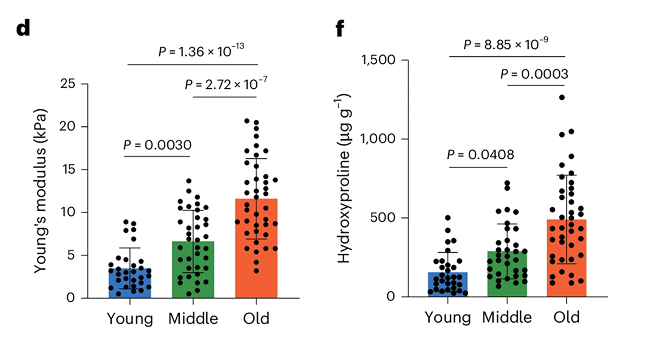
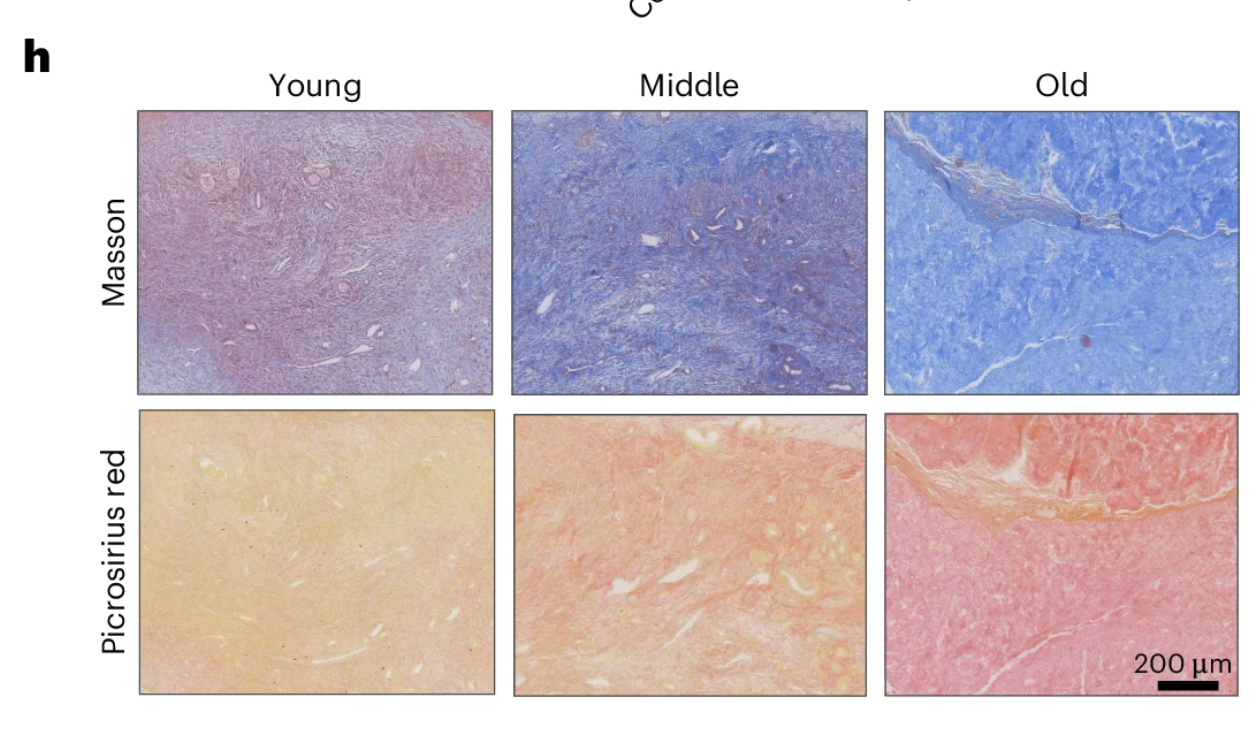
Figure 1: Human ovarian tissue stiffens with age. Atomic force microscopy shows ovarian matrix stiffness rising progressively from young to older donors, alongside increasing collagen content measured biochemically and by staining. The same stiffening appeared in ovaries affected by chemotherapy-induced failure, PCOS, and endometriosis, where tissue from women in their thirties had hardened to levels resembling much older ovaries.
With the physical change established, they went looking for its molecular source. They profiled the proteins present in young, middle-aged, and older human ovaries and asked what changed with age. The aging signature pointed clearly at the extracellular matrix: collagen genes climbing, and the TGF-beta pathway, a master regulator of matrix production, switching on. This confirmed that aging ovaries were running a fibrotic program. But TGF-beta itself is a poor drug target, because it does too many essential things throughout the body, and blocking it causes serious harm. So the researchers looked one step downstream, for a more specific signal that TGF-beta was acting through.
To find it, they treated human ovarian fibroblasts with TGF-beta and watched which genes responded most strongly. One stood out above the rest: IL-11. Its expression jumped higher than any other gene when fibroblasts were activated. This was the lead they followed, and it held up at every turn. IL-11 protein rose with age in ovarian tissue, and not just in humans. It climbed with age in the ovaries of mice and rats as well, the same directional change across three species. As the authors note, this cross-species conservation of age-related IL-11 elevation in the ovary had not been reported before, and conservation across species is one of the stronger hints that a finding reflects something fundamental rather than a quirk of one animal.
Then they tested whether IL-11 was a driver rather than a bystander. When they exposed human ovarian fibroblasts to IL-11 directly, the cells activated, took on the identity of matrix-producing myofibroblasts, and secreted collagen. When they blocked IL-11 with a neutralizing antibody, the fibroblast activation triggered by TGF-beta was abolished. IL-11 was not just present in the aging ovary; it was doing the work, translating the upstream fibrotic signal into the actual production of the matrix that stiffens the tissue. The chain was now visible end to end: age and injury switch on TGF-beta, TGF-beta induces IL-11, and IL-11 drives fibroblasts to lay down the collagen that hardens the ovary.
How IL-11 Hardens the Tissue: The ERK Pathway
Having identified IL-11 as the driver, the researchers traced how it actually works inside the fibroblast, and the answer connects this study to the same growth-signaling machinery that runs through much of aging biology.
IL-11 acts by binding a receptor on the fibroblast surface, and that binding sets off an internal signaling cascade. The researchers systematically blocked each of the candidate pathways one at a time to see which one carried the signal. The answer was ERK, a kinase that sits at the center of one of the cell's principal growth-and-stress signaling routes. When they inhibited ERK, IL-11 lost most of its ability to drive collagen production. When they measured ERK activity directly, it rose with IL-11 stimulation, and it rose with age in both human and mouse ovaries. ERK was the conduit through which IL-11's message became physical matrix.
This matters beyond the mechanical detail, because ERK belongs to the same family of chronic pro-growth signaling that recurs across aging. In the rapamycin and IVF study Healthspan covered, the intracellular driver of ovarian aging was persistent mTOR activity, another growth-signaling pathway stuck in the on position. Here the extracellular driver runs through ERK, a parallel growth pathway, activated by an inflammatory signal from outside the cell. Different pathways, same underlying theme: aging tissue is marked by growth-and-production signals that should switch on and off but instead stay chronically engaged, pushing cells to build when they should be maintaining and repairing.
The single-cell analysis revealed what this does to the population of cells in the ovary, and it added an important refinement. Fibroblasts are not a uniform group. Using single-nucleus RNA sequencing, which reads gene activity one cell at a time, the researchers profiled more than 56,000 individual ovarian cells and found that aging ovaries accumulate a specific subpopulation of activated fibroblasts, cells locked into a high-output state, churning out matrix proteins continuously. These activated fibroblasts were the ones most enriched for ERK signaling, tying the cell state directly back to the IL-11-ERK axis. Aging did not simply make every fibroblast a little more active. It expanded a particular population of hyperactivated, matrix-producing cells, and those were the cells driving the stiffening.
This sets up the study's central test. If IL-11 signaling activates fibroblasts through ERK, and activated fibroblasts are what stiffen the ovary, then cutting off IL-11 signaling should shrink that activated population, soften the tissue, and restore function. The researchers tested exactly that, in several ways.
Using single-nucleus RNA sequencing, which reads gene activity one cell at a time, the researchers profiled more than 56,000 individual ovarian cells and found that aging ovaries accumulate a specific subpopulation of activated fibroblasts, cells locked into a high-output state, churning out matrix proteins continuously.
Proving It: Delete the Receptor, Rescue the Ovary
Everything to this point established that IL-11 rises with age and can activate fibroblasts. But correlation and capability are not causation. To show that IL-11 actually drives ovarian aging, the researchers needed to remove it from the equation and see whether the aging changed. They did this by genetically deleting the receptor that IL-11 signals through, so that the cells could no longer hear its message, and then letting the animals grow old.
The result was a strikingly protected ovary. Aged mice lacking the IL-11 receptor had softer ovarian tissue than their normal littermates of the same age, with less collagen deposition and reduced fibroblast activation, exactly as the mechanism predicts. The reduced ERK activity confirmed the pathway had been interrupted at its source. Removing the ability to receive the IL-11 signal kept the aging ovary from stiffening.
The mechanical protection translated into preserved function, which is the part that matters. Aged mice without the receptor maintained a healthier follicle reserve, with more growing follicles and fewer dying ones. They kept higher levels of anti-Müllerian hormone and estrogen, the hormonal signatures of a younger ovary. They ovulated more eggs when stimulated. And critically, those eggs were not just more numerous but functional: they fertilized and developed into embryos at rates statistically indistinguishable from eggs of control animals. The intervention did not produce more eggs of worse quality; it preserved the machinery that makes good eggs. A softer ovary was a more functional ovary.
Then the researchers asked whether this was specific to normal aging or a more general property of ovarian injury, and this is where the finding broadened considerably. They tested the same receptor deletion in two very different disease models. In chemotherapy-induced ovarian failure, where toxic drugs stiffen and scar the ovary, deleting the IL-11 receptor blunted the stiffening and preserved follicles and hormone levels. In a model of PCOS, the same deletion reduced ovarian stiffness, normalized the elevated testosterone that defines the condition, and restored more regular ovulation. Three different insults, normal aging, chemotherapy, and the hormonal dysfunction of PCOS, all converging on the same mechanism, and all mitigated by blocking the same signal.
That convergence is one of the most important results in the study. It suggests IL-11-driven stiffening is not a quirk of one kind of ovarian damage but a common pathway through which many different insults impair the ovary. Whatever starts the process, aging, toxins, or hormonal disorder, it appears to run through the same molecular bottleneck, which makes that bottleneck an unusually attractive target. But a genetic knockout, present from birth, is a proof of mechanism, not a treatment. The question that determines whether any of this could matter clinically is different: could you block IL-11 in an animal that had already aged, and reverse what had already set in?
Aged mice without the receptor maintained a healthier follicle reserve, with more growing follicles and fewer dying ones. They kept higher levels of anti-Müllerian hormone and estrogen, the hormonal signatures of a younger ovary. They ovulated more eggs when stimulated. And critically, those eggs were not just more numerous but functional: they fertilized and developed into embryos at rates statistically indistinguishable from eggs of control animals.
The Therapeutic Test: Reversing Aging That Had Already Set In
A genetic knockout answers a question about mechanism, but it cannot become a treatment. The animals were engineered from conception to lack the IL-11 receptor in every cell, so their ovaries never stiffened in the first place. That is prevention of the most absolute kind, and it tells you nothing about whether you could intervene in an ovary that had already aged. Real reproductive aging arrives in bodies that developed normally and then grew old. The question that matters clinically is whether the process can be reversed after the fact, and this is the test the study built toward.
To run it, the researchers needed a way to switch off IL-11 in an already-aged animal, without genetic engineering. They turned to a technology that has recently matured into approved medicines: small interfering RNA, or siRNA, short strands of genetic material designed to silence a specific gene by intercepting its messages before they can be translated into protein. They designed an siRNA to silence IL-11, packaged it into lipid nanoparticles, the same broad class of delivery vehicle used in the mRNA vaccines, and injected it into the bloodstream of reproductively aged mice and rats. The animals were middle-aged, well into ovarian decline, with stiffening already established.
The treatment reversed it. In the aged mice, ovarian stiffness dropped by roughly a third after treatment. Collagen content fell. The activated fibroblast markers and ERK signaling that drive the stiffening came back down. This was not prevention in an animal engineered to never age; it was a reduction in stiffness that had already accumulated in a normally aged ovary, produced by a drug given in adulthood.
And the softened tissue regained function. The treated mice grew more healthy follicles, ovulated more eggs, and, most consequentially, became more fertile. Aged mice given the IL-11 siRNA produced more pups per litter than untreated controls. The same experiment in aged rats reproduced the result: less stiffness, less collagen, better follicle development, higher pregnancy rates, and larger litters. Two species, the same reversal, in animals treated only after they had already aged.
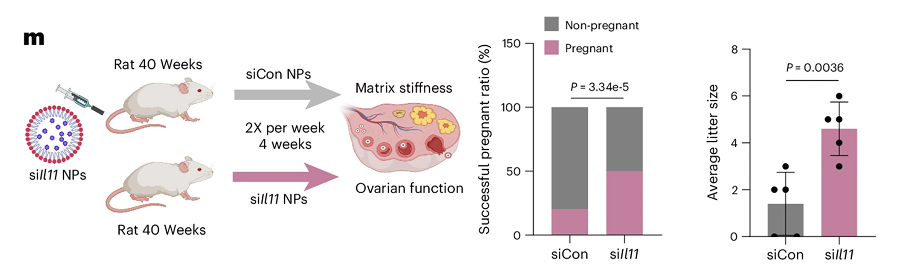
Figure 2: Silencing IL-11 reverses ovarian stiffening after aging. An siRNA against IL-11, delivered by nanoparticle to reproductively aged mice and rats, reduced ovarian stiffness by roughly a third, lowered collagen, restored follicle development, and improved fertility, producing larger litters and higher pregnancy rates. The animals were treated only after aging was already established.
The researchers ran one further control that strengthens the interpretation. To be sure the benefit came from the ovary itself and not some indirect whole-body effect of the injection, they used a separate technique to knock down the IL-11 receptor locally, in the ovary alone. The local intervention reproduced the benefits, softer tissue and better ovarian function, which indicates the effect is genuinely local to the ovary rather than a secondary consequence of altering IL-11 signaling elsewhere in the body.
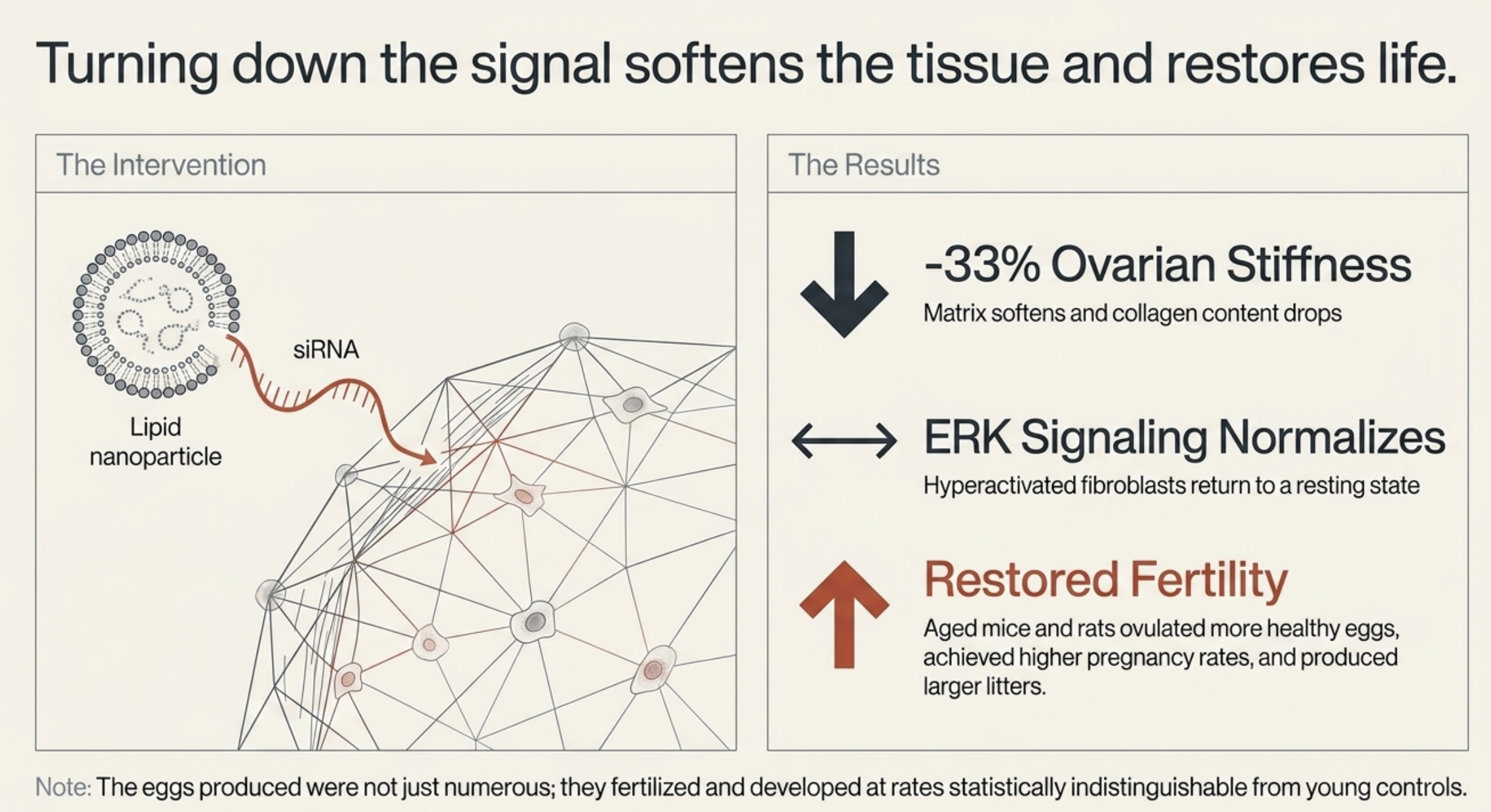
This is the result that gives the study its weight. Restoring fertility in an aged animal, with a drug delivered systemically in adulthood, is a categorically different achievement from preventing aging in a genetically engineered one. It moves the finding from "IL-11 causes ovarian stiffening" to "blocking IL-11 can reverse ovarian stiffening after it has occurred," which is the claim that would matter for a person. The distance from a treated mouse to a treated human remains large, and the next sections lay out exactly how large. But the core demonstration, that an already-stiffened ovary can be softened and made functional again by turning down a single signal, is what makes this more than a mechanistic curiosity.
What this Means for IL-11 as a Longevity Target
Everything so far has been about the ovary, but the reason this study belongs in a longevity publication rather than only a reproductive one is that IL-11 is not an ovarian signal. It is a systemic one, and it has recently become one of the more interesting targets in aging research generally.
The pivotal finding came in 2024, when a study in Nature reported that inhibiting IL-11 extended both healthspan and lifespan in mice. Animals treated with an anti-IL-11 antibody in later life lived meaningfully longer and aged better, with reductions in the frailty, metabolic decline, and multi-organ deterioration that accompany normal aging. That is a rare result. Very few interventions extend maximum lifespan in mammals, and fewer still do it when begun in already-old animals. IL-11 inhibition did, which vaulted it into the small group of genuinely promising longevity targets.
What makes IL-11 such a compelling target is the breadth of what it appears to drive. IL-11 rises with age across many tissues, and it promotes the same fundamental process nearly everywhere it acts: the activation of fibroblasts, the deposition of matrix, and the inflammation that accompanies them. This is why anti-IL-11 therapies are already in development for fibrotic diseases of the heart, the kidney, and the lung, organs whose age-related failure is driven substantially by exactly the stiffening this study describes. The ovarian finding slots into that larger program as another instance of the same mechanism, in an organ where the functional consequence, lost fertility and hormone production, happens to be especially clear and especially early.
Seen this way, the study is a piece of a convergent story the field has been assembling. Aging tissue stiffens. The stiffening is driven in large part by chronically activated fibroblasts. IL-11 is a central signal telling those fibroblasts to activate. And blocking IL-11, in the ovary as in the heart, kidney, and lung, softens the tissue and restores function. If that pattern holds across organs, then IL-11 represents something the field is always hunting for and rarely finds: a single intervention point that addresses a shared driver of aging across multiple systems, rather than a separate fix for each failing organ.
There is also a practical reason this matters more than a typical mechanistic result. Because anti-IL-11 antibodies are already being tested in humans for other conditions, the safety and pharmacology groundwork is being laid in parallel. A target that is simultaneously implicated in reproductive aging, cardiac fibrosis, kidney disease, lung disease, and lifespan itself, and that already has drugs moving through human trials, is positioned to translate faster than a finding that starts from scratch. That does not shortcut the work still required to prove it helps human ovaries specifically, which remains entirely undone. But it means the path is shorter than it looks.
The Complication: IL-11 Is Not Simply Bad
A finding this clean invites an oversimplified conclusion, that IL-11 is a harmful signal and less of it is always better. The study is careful to head that off, and the complication it addresses is important enough to spell out, because it is exactly the kind of nuance that separates a real therapeutic strategy from a naive one.
Here is the tension. This study, and the broader IL-11 literature, shows that blocking IL-11 in aged animals reverses fibrosis and restores function. Yet other research has shown that animals engineered to completely lack IL-11 or its receptor from birth are infertile. If IL-11 is bad for the ovary, why would removing it entirely cause the very outcome the ovary is meant to produce?
The resolution is that IL-11 has different roles at different stages of life, and the dose and timing are everything. During development and normal reproductive function, IL-11 does necessary work; complete absence from conception disrupts that work and causes infertility. But when IL-11 becomes chronically elevated in aging, it shifts from doing its normal job to driving pathological fibrosis. The problem in the aging ovary is not that IL-11 exists; it is that there is too much of it, for too long. This distinction shows up directly in the study's own data: animals with only one working copy of the receptor, and therefore reduced but not absent signaling, were fertile and normal. It is the excess that is pathological, not the presence.
This is why the therapeutic approach the study points toward is partial, adult-onset reduction, not total elimination. The siRNA treatment lowered IL-11 in already-aged animals; it did not abolish it from birth. That difference is the whole game. A treatment that trims chronic, age-driven overexpression back toward youthful levels is doing something fundamentally different from a genetic deletion that removes the signal entirely across a lifetime. The authors make this point explicitly to reconcile their fertility-restoring result with the older infertility findings, and it is a genuinely important piece of biological reasoning, not a hand-wave.
The broader lesson generalizes beyond IL-11. Many signals that become harmful in aging are not intrinsically bad; they are necessary systems that were calibrated for youth and become destructive when they run too hot for too long. mTOR, the target of the rapamycin story, is the same kind of signal: essential for growth and development, damaging when chronically overactive in age. These two signals are not even fully separate. IL-11 can itself activate mTOR downstream of its receptor, and both converge on the same endpoints, chronic fibroblast activation and the failure of cellular maintenance, so the intracellular overdrive of the rapamycin story and the extracellular stiffening of this one are better understood as connected entry points into one pro-growth signaling network than as two isolated mechanisms. The therapeutic goal in every case is the same: not to eliminate the signal but to restore it to a more youthful set point. This reframing, aging as the dysregulation of essential signals rather than the mere presence of bad ones, is one of the more useful ideas running through modern longevity science, and IL-11 is a clean example of it.
The Limitations of the Study
The gap between this study and anything a person could use is wide, and several limitations define it. They do not undermine the science, which is careful and thorough, but they set firm boundaries on what can be claimed.
The reversal was demonstrated in animals, not people. The restored fertility, the softened tissue, the improved ovulation, all of it happened in mice and rats. The human component of the study established only that ovarian stiffening correlates with age and disease. No human has been treated with anti-IL-11 for ovarian aging, and the leap from rodent ovaries to human ones has defeated many interventions that looked convincing at this stage. Rodent and human reproductive aging differ in pace, hormonal detail, and scale, and a result in a mouse is a reason to test in humans, not a preview of what will happen when someone does.
The treatment was systemic, not targeted. The siRNA nanoparticles were injected into the bloodstream and distributed throughout the body, not delivered specifically to the ovary. IL-11 does necessary work in other tissues, including wound healing, so a systemic reduction carries the potential for off-target effects that this study was not designed to detect. The authors flag this directly and note that ovary-targeted delivery would be needed for a real therapeutic, which is a substantial piece of engineering that does not yet exist.
The model was prevention of progression, not late-stage reversal. The treated animals were middle-aged, at a stage of active ovarian decline, which corresponds to a woman in her late thirties or forties, not one past menopause. The study shows that intervening during that decline can push it back. It does not show that a long-depleted, post-menopausal ovary could be restored, and the authors are explicit that reversing established, late-stage fibrosis is a separate question their data does not answer. The intervention slowed and partly reversed an ongoing process; it was not tested against a finished one.
Safety and durability are unaddressed. The study does not establish how long the benefits last after treatment stops, whether repeated dosing would be required, or what chronic IL-11 suppression might do over time. And fertility was the endpoint measured. Whether reducing ovarian IL-11 would meaningfully delay menopause, or the downstream consequences of estrogen loss such as bone and cardiovascular decline, is a reasonable hypothesis the study raises but does not test.
Finally, the human tissue findings, while consistent, are correlational. Stiffness rose with age and disease in human ovaries, and IL-11 rose alongside it, but causation in humans was not established. That the causal chain held in animals makes the human correlation more compelling, but it remains an inference, not a demonstration, in our own species.
The Ovary Is the Proof, Not the Point
Three implications follow from this work, moving outward from the ovary to aging as a whole.
The first is specific to reproductive aging, and it completes a picture Healthspan has been assembling in pieces. The ovary, it now appears, ages on two fronts at once. From inside the egg and its supporting cells, chronic mTOR signaling drives the ribosomal overdrive and proteostatic collapse that the rapamycin and IVF study described, degrading egg quality from within. From outside the cell, IL-11-driven stiffening of the surrounding matrix mechanically shuts down follicle development, degrading the ovary from without. These are not competing theories of ovarian aging; they are two real, simultaneous processes, and each has a candidate intervention, rapamycin for the intracellular arm, anti-IL-11 for the extracellular one. The most interesting open question is whether they are additive, whether addressing both the internal overdrive and the external stiffening together could preserve ovarian function better than either alone. That is a study someone should run.
The second implication reframes reproductive aging itself. The ovary has long been treated as running on a fixed clock, a reserve set at birth that only depletes, on a schedule nothing can alter. This study complicates that fatalism. Part of the ovary's functional decline turns out to be not depletion but obstruction, a mechanical barrier of stiffened tissue that impairs follicles which are still present and still viable. Remove the barrier, and function returns. This does not mean the clock is fake; egg count genuinely falls with age and that remains real. But it means a meaningful part of the decline may be a treatable tissue state rather than an immovable count, which is a genuinely different and more hopeful way to think about the aging ovary.
The third implication is the broadest, and it is why this study matters to anyone regardless of reproductive interest. The stiffening this study dissects in the ovary is the same process that hardens the aging heart, kidney, lung, and artery, and it appears to run through the same signal. IL-11 is emerging as a common driver of the fibrosis and inflammation that degrade organ after organ with age, and blocking it has already been shown to extend lifespan in mice. What the ovary provides is an unusually clean proof of the underlying principle: that age-related stiffening is not fixed scenery but an actively maintained process, held in place by a signal, and reversible when that signal is turned down. If that principle holds across organs, and the evidence increasingly suggests it does, then IL-11 is the rare target that addresses a shared mechanism of aging rather than a single disease, in a body that stiffens everywhere at once.
The honest clinical position sits underneath all three. This is an animal result with a strong human rationale and a target already moving through human trials for related conditions. It is not a treatment anyone can use today, and it is not a reason to seek out IL-11-blocking drugs for aging or fertility. It is a reason for serious scientific interest, and a genuinely promising direction, which is different from an answer.
Conclusion: The Stiffening Is Not Fixed
We tend to imagine aging as accumulation and depletion, things building up that should not, things running down that cannot be refilled. The ovary is often held up as the purest example: a fixed reserve, set before birth, counting down on a schedule indifferent to anything we do. This study does not overturn that picture, but it reveals something underneath it that is more malleable than the fatalism suggests.
Part of the aging ovary's decline is not depletion at all. It is stiffening, an active hardening of the tissue around follicles that are still there and still capable, driven by a single inflammatory signal that rises with age. And unlike a depleted reserve, stiffening can be undone. When the researchers turned down IL-11 in animals that had already aged, the tissue softened, the follicles resumed developing, and fertility returned. A process that looked like irreversible decline turned out to be an actively maintained state, held in place by a signal that could be switched off.
The importance of this reaches well past the ovary, which is why the ovary was the right place to prove it. The same stiffening hardens the aging heart, the kidney, the lung, and the arteries, and it appears to run through the same signal, one already shown to extend lifespan in mice when blocked. The ovary simply makes the principle impossible to miss, because there the cost of stiffening, and the benefit of reversing it, shows up with unusual speed and clarity. What the study demonstrates in one organ is a claim about aging in general: that a defining feature of growing old, the slow hardening of the body's tissues, may be less a fixed trajectory than a maintained condition, with a cause that can be identified and a signal that can be turned down.
None of this is a treatment yet, and the distance to one is real. No human has been treated, the delivery is not yet targeted, and the hardest version of the problem, restoring tissue that has already finished aging, remains untested. But the conceptual result stands on its own. For a long time the stiffening of aging tissue was assumed to be permanent, the mechanical residue of time itself. This study, in one revealing organ, shows that it is not. The scaffolding hardens because something keeps hardening it, and when that something is removed, even an aged tissue can soften and work again. That is a different picture of aging than the one we started with, and a more hopeful one.
- Wu, M., Zhu, Q., Xiong, J. et al. Modulating IL-11-dependent matrix stiffness to delay ovarian aging. Nat Aging 6, 1395–1416 (2026). https://doi.org/10.1038/s43587-026-01159-2
- Widjaja, A.A., Lim, WW., Viswanathan, S. et al. Inhibition of IL-11 signalling extends mammalian healthspan and lifespan. Nature 632, 157–165 (2024). https://doi.org/10.1038/s41586-024-07701-9
- Li, J., Wang, H., Zhu, P. et al. Ribosome dysregulation and intervention in age-related infertility. Cell Rep Med 6, 102424 (2025). https://www.cell.com/cell-reports-medicine/fulltext/S2666-3791(25)00497-5
Related studies