Rapamycin and Cerebral Blood Flow in APOE4 Carriers: An Early, Genotype-Specific Signal
Prefer to listen? Hit play for a conversational, audio‑style summary of this article’s key points.
The first human trial of rapamycin in APOE4 carriers tested whether it could act on the earliest brain changes of Alzheimer's risk. Researchers gave low-dose rapamycin (1 mg/day for four weeks) to cognitively normal, middle-aged adults, and compared nine APOE4 carriers, the highest genetic-risk group, against fourteen non-carriers. The goal was prevention in its truest sense: intervening in the silent, presymptomatic window, decades before symptoms, in the people most likely to need it.
Rapamycin improved cerebral blood flow, but only in the APOE4 carriers. After four weeks, carriers showed a significant increase, more than 15%, in blood flow to brain regions that decline earliest in Alzheimer's, including the precuneus and parietal cortex. Non-carriers, on the identical drug, showed no change. The same medication did different things depending on a person's genes.
An exploratory analysis suggested the effect was concentrated in women, but it rests on very few people. Female carriers showed the largest increases (roughly 30% in the hippocampus, 35% across the cortex), while male carriers and all non-carriers showed little change.
The effects extended beyond the brain, in the same genotype-specific pattern. In carriers, rapamycin was associated with higher short-chain fatty acids in the blood, a drop in one inflammatory marker (MCP-1), and shifts in lipid and energy metabolism, though interleukin-6 rose in both groups.
Introduction: Testing a Longevity Drug Against Alzheimer's Risk, Before Symptoms Begin
People who carry the APOE4 gene variant have a much higher risk of developing late-onset Alzheimer's disease. Having one copy of APOE4 increases risk several times above average, and having two copies can raise risk more than tenfold. Research suggests that the changes resulting in Alzheimer's begin many years before symptoms appear, often starting in midlife when people still feel healthy. Until now, there have been very few options for people who know they carry this risk. There is still no proven way to prevent Alzheimer's.
The gap between knowing you are at risk for Alzheimer's and having options to act on that risk is significant. This is why a recent small study is important. Researchers at the University of Missouri conducted the first human trial to see if rapamycin, a drug known in longevity research for extending lifespan in animals, could help address early brain changes in people with the APOE4 gene. These participants were middle-aged and still cognitively healthy. The goal was to test prevention at its earliest stage, before any symptoms appear, by intervening during the period when the first biological changes begin in those most at risk.
The result was striking, and genuinely unexpected in one respect. After four weeks of low-dose rapamycin, the APOE4 carriers showed a significant increase in blood flow to the brain, specifically in the regions that falter earliest in Alzheimer's. The non-carriers, given the same drug, showed no such change. The medication appeared to do different things depending on a person's genes, a pattern that, if it holds up, points toward an idea reshaping how researchers think about prevention: that it may need to be personalized down to the genotype.
This is an early, preliminary signal, not a finding that rapamycin prevents Alzheimer's or improves cognition. Nobody should read it that way, and the researchers do not claim it. It is, however, a genuinely interesting result, and a window into where Alzheimer's prevention research is heading: earlier, into the presymptomatic window; more personal, designed for genetic risk; and increasingly willing to test the tools of longevity science against the specific, early biology of the disease. What follows is why APOE4 carriers are vulnerable in the first place, why blood flow is a meaningful place to intervene, what the study found across the brain and body, and what it does and does not tell us.
Why Researchers Focused on APOE4 and Blood Flow
To understand what this study was testing, you have to understand two things: what makes APOE4 so dangerous for the brain, and why something as seemingly mundane as blood flow sits near the center of the story.
APOE is a gene everyone carries, and it comes in a few common versions, of which APOE4 is the one that raises Alzheimer's risk. Its normal job is to help manage fats and cholesterol, including in the brain, where lipid handling is essential to keeping neurons and their connections healthy. The APOE4 version does this job less well, and the consequences extend outward: it is associated with impaired clearance of the amyloid protein that accumulates in Alzheimer's, with more inflammation, with disrupted brain metabolism, and, importantly for this study, with problems in the brain's blood vessels. Carrying one copy raises Alzheimer's risk several times over; carrying two can raise it more than tenfold. It is the single strongest common genetic risk factor for the disease.
What is easy to miss is how early the process starts. The plaques, the tangles, and the memory loss they eventually cause are the late stages of a process that begins decades earlier.
In APOE4 carriers, some of the earliest measurable changes, detectable in people who are still cognitively normal and feel perfectly fine, are vascular and metabolic. The brain's blood flow begins to decline. Its use of glucose for fuel becomes less efficient. Low-grade inflammation rises. These shifts appear in the presymptomatic window, long before anything that would prompt a doctor's visit, and they are increasingly understood not as incidental background to Alzheimer's but as part of what drives it forward. This is why that window matters so much: it is when the disease is first taking hold, and when there may still be the most room to change its course.
Blood flow, in particular, deserves attention, because it is more consequential than it sounds. The brain is extraordinarily dependent on a constant, generous supply of blood. It cannot store fuel, so it relies on steady delivery of oxygen and glucose through a dense network of vessels, and it tunes that delivery moment to moment to match the activity of different regions. When cerebral blood flow declines, neurons are left underserved, and over years, that chronic underperfusion contributes to their dysfunction and loss. Reduced cerebral blood flow is not simply a marker that travels alongside Alzheimer's risk; it is thought to be one of the mechanisms whereby that risk plays out. Improving it while a person is still healthy is a plausible way to protect the brain, which is why the researchers chose it as their primary target.
One more detail makes this study's design particularly important. APOE4 vulnerability is not evenly distributed. Women who carry APOE4 appear to face a higher Alzheimer's risk than men who carry it, for reasons still being worked out but likely tied to hormonal and vascular differences. That detail matters because it foreshadows one of the study's more intriguing, if preliminary, findings: the drug's effect on brain blood flow was not the same in men and women.
Why Rapamycin
If the problem is the earliest vascular and metabolic drift in a high-risk brain, why reach for rapamycin, a drug most people have never heard of, and that was not designed for anything like this? If you are a reader of our work, you may already know the answer: rapamycin's ability to target one of the most studied pathways in all of aging biology.
Rapamycin is a compound originally discovered in a soil bacterium and first used in medicine to suppress the immune system in organ-transplant patients. Its relevance to aging comes from what it acts on: a cellular hub called mTOR, which stands for the mechanistic target of rapamycin, the protein named after the drug that inhibits it. mTOR functions as a master sensor of a cell's circumstances, detecting nutrients, growth factors, and energy status, and deciding accordingly whether the cell should be in a mode of growth and synthesis or one of maintenance and cleanup. When nutrients are plentiful, mTOR drives growth. When rapamycin dials mTOR down, it shifts cells toward the maintenance mode, including a key self-cleaning process called autophagy, in which cells clear out defective components.
This matters for aging because chronically elevated mTOR signaling is one of the recurring themes of growing older, and dialing it back has proven to be one of the most reliable ways to slow aging in the laboratory. Rapamycin extends lifespan in yeast, worms, flies, and mice, making it one of the few interventions with that distinction across species. And beyond lifespan, it has effects that bear directly on the biology this study cares about: in animal work, rapamycin has been shown to improve the function of blood vessels, restore mitochondrial activity, promote the cellular cleanup of autophagy, and reduce the accumulation of the amyloid and tau proteins associated with Alzheimer's. In short, it acts on several of the exact systems, vascular, metabolic, and protein-clearance, that go wrong early in APOE4 carriers. And that evidence is increasingly moving into people: in just the past year, low-dose rapamycin has produced encouraging proof-of-concept results across a striking range of conditions, from chronic fatigue syndrome to heart failure to ovarian and reproductive aging. This Alzheimer's study is the latest in that wave, testing the same drug against the earliest biology of the disease.
The bridge from animals to this trial is specific. Earlier studies in mice engineered to carry the human APOE4 gene found that rapamycin could counter some of the APOE4-driven damage, improving brain blood flow and metabolism and reducing amyloid buildup. That is the finding the researchers set out to test in people: whether the benefit seen in APOE4 mice would translate to APOE4 humans, in the same early, presymptomatic window.
Two practical points made rapamycin a reasonable candidate to try. First, it is already approved and familiar, with a long track record in medicine, so its safety profile is well understood. Second, the dose matters enormously. The study used a low dose, one milligram per day, far below the amounts used to suppress the immune system in transplant patients. At these low doses, rapamycin and related compounds have been studied in older adults with generally mild side effects, and have even been shown to improve the immune response to vaccination, the opposite of the immune suppression seen at high doses. This is the version of rapamycin that longevity medicine has taken interest in: low, carefully dosed, and aimed at tuning a master aging pathway rather than shutting down the immune system.
The Study
The trial was deliberately modest in scope, built as a proof-of-concept pilot to see whether the idea was worth pursuing at larger scale, and its design is important to understand clearly, because it shapes exactly how much weight the findings can bear.
The researchers enrolled twenty-three cognitively normal adults between the ages of 45 and 65, confirmed to have normal cognition on a standard screening test and free of diabetes. The crucial feature was the genetic split: each participant was genotyped for APOE, and the group divided into nine APOE4 carriers and fourteen non-carriers. This two-group structure is the heart of the study, because the central question was not simply whether rapamycin does something, but whether it does something different depending on a person's genetic risk.
Every participant took the same regimen: low-dose rapamycin, one milligram per day, for four weeks. Before starting, each underwent a baseline brain MRI to measure cerebral blood flow, done twice to confirm the measurement was reproducible, along with blood draws and a stool sample to capture their starting metabolic, inflammatory, and gut-microbiome state. After the four weeks, the same measurements were repeated, so each person served as their own point of comparison, before versus after. The primary endpoint, the main thing the study was designed to detect, was the change in cerebral blood flow. Secondary endpoints tracked shifts in blood metabolites and short-chain fatty acids, markers of Alzheimer's-associated proteins, inflammatory signaling molecules, and the composition of the gut microbiome.
Each of these secondary measures was chosen because it reflects a system that APOE4 is known to disturb, which is what made them worth watching for a rapamycin effect. The blood metabolites, many of them tied to how the body handles fats and energy, matter because APOE4 impairs lipid handling and brain fuel metabolism, so shifts there could signal whether rapamycin was improving the underlying metabolic environment. The markers of Alzheimer's-associated proteins, a tau marker and an amyloid-related inflammatory protein measured in the blood, were included to see whether anything was moving on that front, though as we will see they are an indirect readout rather than a measure of brain plaques. The inflammatory signaling molecules were included because chronic, low-grade inflammation is part of the early APOE4 cascade, and rapamycin is known to modulate immune activity.
The short-chain fatty acids and the gut microbiome are the least obvious inclusions, and the most interesting. Short-chain fatty acids are molecules like butyrate and propionate that gut bacteria produce when they ferment dietary fiber, and they have become a focus of brain-aging research through what is called the gut-brain axis, the growing recognition that the gut's microbial ecosystem communicates with and influences the brain, partly through these very molecules, which help regulate inflammation and support the barriers that protect both gut and brain. APOE4 carriers tend to have altered gut microbiomes and lower levels of these beneficial compounds, and the APOE4 mouse studies that inspired this trial had found that rapamycin could shift the gut in a favorable direction. So the researchers measured the microbiome and its short-chain fatty acid output to test whether rapamycin was reaching all the way down to the gut, on the theory that a healthier gut ecosystem is one more lever on the inflammatory and metabolic environment the aging brain depends on.
Two features of the design deserve to be named plainly, because they bound the conclusions. First, there was no placebo group. Everyone knew they were taking rapamycin, and there was no comparison arm taking an inactive pill. This is common and reasonable for an early pilot, but it means the study cannot fully rule out that some of the changes reflect the passage of time, the natural variation in these measurements, or the expectation of benefit, rather than the drug itself. The genotype comparison partly mitigates this, since both groups took the same drug yet responded differently, which is harder to explain away, but the absence of a placebo is a real limit. Second, the sample was small, and some of the most interesting analyses, particularly the comparison between men and women, rest on only a handful of people, which makes them exploratory rather than conclusive.
What the design does well is use a precise, individual-level measurement, MRI-based blood flow, that can detect real change even in a small group, and pair it with a genetic stratification that turns a simple before-and-after pilot into a test of a more sophisticated idea. What it cannot do is prove that rapamycin prevents Alzheimer's, improves cognition, or works the same way in the wider population. It was built to find a signal worth pursuing, not to deliver a verdict, and it should be read in that spirit.
The Primary Finding: Blood Flow Rose, but Only in the Carriers
The main result was clear, and it was specific in a way the researchers had hoped for. After four weeks of low-dose rapamycin, the APOE4 carriers showed a significant increase in cerebral blood flow, more than 15%, across a range of brain regions. The non-carriers, taking the identical drug for the identical time, showed no significant change in blood flow at all.
The regions where the carriers' blood flow improved are what make the finding even more interesting. The increases appeared in the frontal, parietal, and occipital areas of the cortex, and in specific structures including the caudate nucleus, the inferior parietal cortex, the lateral occipital cortex, and the precuneus. These are not random patches of brain. They are regions heavily involved in cognition, and several of them, the precuneus and parietal areas in particular, are among the earliest to show reduced blood flow and metabolic decline in the preclinical stages of Alzheimer's. In other words, rapamycin raised perfusion precisely in the places where APOE4 carriers tend to lose it first. The drug appeared to be pushing back against the specific early vulnerability.
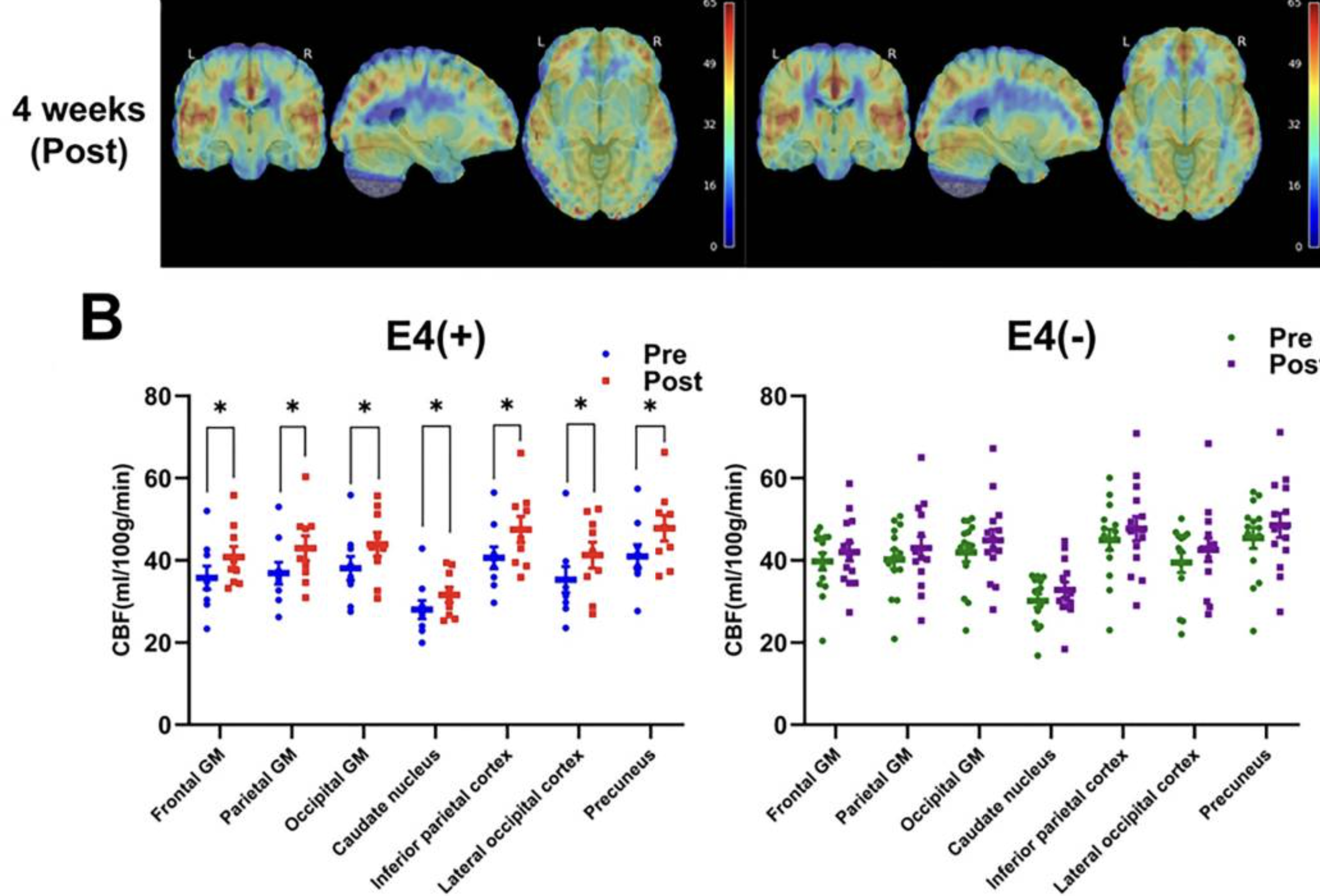
At baseline, before any treatment, the APOE4 carriers tended to have somewhat lower brain blood flow than the non-carriers, an average of about 33.6 versus 36.8 milliliters per 100 grams of tissue per minute. That gap was not large enough to reach statistical significance in a group this size, so it should be read as a trend rather than a firm difference. The direction fits the larger picture: carriers beginning from a slightly disadvantaged position, consistent with vascular drift already underway even though they were cognitively normal, and then responding to the drug in a way the non-carriers did not.
That genotype-specific pattern is the piece we cannot gloss over. If rapamycin had raised blood flow in everyone, it would suggest a generic vascular effect. Instead, it raised blood flow in the people whose genetics put them at higher risk and whose vascular function was likely already beginning to falter, while leaving the non-carriers unchanged. This is consistent with something more precise: that rapamycin may act on a deficit that is present in carriers and largely absent in non-carriers, so that the same drug finds something to fix in one group and little to change in the other. It is the difference between a tool that does the same thing to each surface and one that only engages where there is a specific problem to address.
The study showed a significant change in the carriers and no significant change in the non-carriers, which are two separate comparisons. On their own, two such results do not formally prove that the two groups responded differently from each other, a conclusion that requires a direct statistical test comparing the two groups' changes. The pattern is suggestive, and it is exactly what the study was designed to look for, but it is best read as an apparent genotype-dependent response worth confirming, rather than a difference the data have definitively established.
An increase in cerebral blood flow is a change in a risk-associated measurement, not a change in the disease itself. It is a plausible and mechanistically reasonable thing to want to improve, and improving it in exactly the vulnerable regions is encouraging. Blood flow is a surrogate, a stand-in for the underlying biology, though, not a demonstration that cognition was protected or that Alzheimer's was averted. The study shows rapamycin moved a meaningful early marker in the right direction, in the right people, over four weeks. Whether that holds over years, and whether it changes the path toward dementia, is the question this result raises and cannot yet answer.
The Sex Difference
When the researchers broke the results down by sex, the increase in brain blood flow among the APOE4 carriers turned out to be driven almost entirely by the women.
The numbers, for the female carriers, were large. Blood flow rose by roughly thirty percent in the hippocampus, the structure most central to memory and among the first damaged in Alzheimer's, by about thirty-five percent across the cortex, and by a similar amount across the whole brain. A region-by-region look found increases exceeding twenty percent in most areas, with the inferior temporal gyrus showing the largest jump, around forty-five percent. By contrast, the male carriers, and both the male and female non-carriers, showed negligible changes. The effect, in this small sample, was concentrated in one group: women carrying APOE4.
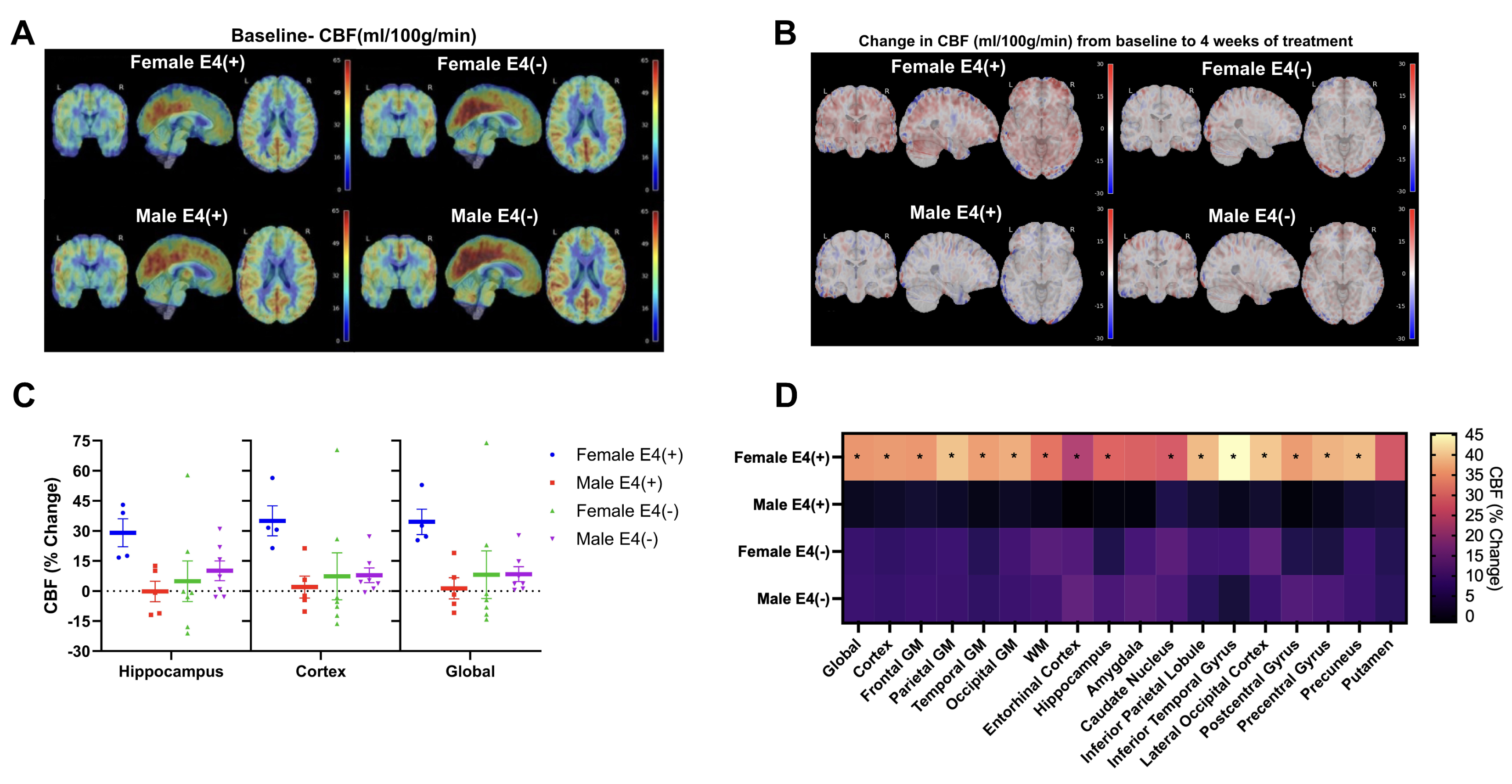
Figure 2: The blood-flow increase was concentrated in female carriers (exploratory). In a sex-stratified analysis, female APOE4 carriers showed the largest perfusion increases, roughly 30% in the hippocampus and 35% across the cortex, while male carriers and all non-carriers showed little change. Because this rests on a very small subgroup, it is an exploratory finding and a hypothesis for larger trials, not a conclusion.
If it holds, this seems to be a genuinely important pattern, because it maps onto one of the real puzzles of Alzheimer's. Women are disproportionately affected by the disease, and women who carry APOE4 appear to bear a higher risk than men who carry the same variant. The reasons are thought to involve the relationship of APOE4 with hormonal changes around menopause and with sex differences in the brain's blood vessels. A drug that preferentially restored blood flow in exactly the group at highest risk would therefore be a striking and clinically meaningful finding. It would suggest that the women who stand to lose the most might also be the ones who respond best to early intervention.
We have to remember, though, that this was a very small study. The female APOE4 carriers were a subset of a subgroup, a handful of individuals out of twenty-three. With numbers that small, a striking result can arise from chance, from the particular biology of a few people, or from the ordinary variability that any measurement carries, and it cannot be reliably separated from a true effect. The researchers are appropriately careful to label this as exploratory, a hypothesis to be tested rather than a conclusion to be trusted. It is the kind of signal that makes a larger, properly designed trial worth running, specifically one built to compare men and women. It is not, on its own, evidence that rapamycin works better in women. It is a reason to go find out.
Metabolism, Inflammation, and the Gut
The brain blood-flow result was the primary finding, but the researchers also looked at what rapamycin did throughout the body, in the blood and in the gut, and here too the theme of genotype-specific responses held. The same drug produced different patterns of change in carriers than in non-carriers, supporting the study's central idea that genetics shapes the response.
Short-chain fatty acids are beneficial molecules, including butyrate and propionate, produced when gut bacteria ferment dietary fiber. They support the health of the gut lining, help regulate inflammation, and are increasingly understood to influence the brain through the gut-brain axis.
In the APOE4 carriers, rapamycin was associated with an increase in these beneficial short-chain fatty acids in the blood, while the non-carriers showed no such increase. It is tempting to connect this to the gut bacteria themselves, and the two are plausibly related, but here the evidence is weaker and should be read cautiously. The study found that the carriers and non-carriers had distinctly different gut microbiomes to begin with, a baseline genotype difference, but it did not find a statistically significant change in the microbiome from the rapamycin treatment itself, and the specific bacterial species that stood out did not survive the statistical correction for testing many organisms at once. So while the short-chain fatty acid rise in the blood is a real signal worth noting, the tidy story of rapamycin remodeling the gut to produce it is more hypothesis than finding. What the microbiome data more firmly show is that APOE4 status is associated with a different gut ecosystem, not necessarily that rapamycin reshaped it.
On the inflammatory side, the picture was more mixed. It was not uniformly favorable. In the carriers, rapamycin reduced a key inflammatory signaling molecule called MCP-1, a regulator of inflammation and tissue damage, which is a change in a helpful direction. At the same time, the drug also increased interleukin-6, a major pro-inflammatory cytokine, in both groups, which cuts the other way. Inflammatory signaling is complex, and a single intervention often moves different markers in different directions rather than simply turning inflammation up or down. The accurate summary is that rapamycin modulated inflammation in a genotype-specific pattern, lowering some markers and raising others, rather than producing a clean anti-inflammatory effect.
The metabolic findings followed the same genotype-specific logic. In the carriers, rapamycin shifted several metabolites involved in lipid and energy metabolism, including a rise in a molecule central to the processing of fats and sugars. The non-carriers showed a different metabolic pattern, with changes in a separate set of molecules. The specific metabolites are less important for a general reader than the overall shape of the result: that rapamycin reached well beyond the brain, touching metabolism, inflammation, and the gut, and that what it did in each of these systems depended on whether a person carried APOE4.
What Didn't Change: The Protein Markers
One set of results deserves careful attention, and careful description, because it is easy to get wrong. The researchers measured two blood-based protein markers related to Alzheimer's: serum amyloid A and a form of tau called phosphorylated tau. Neither changed significantly over the four weeks, in either the carriers or the non-carriers.
The naming here matters, and it is worth being precise where the science often is not. Serum amyloid A is an acute-phase inflammatory protein produced largely by the liver. Despite the similar name, it is not the same as amyloid-beta, the peptide that forms the plaques in the Alzheimer's brain. The study measured serum amyloid A in the blood, not the plaque-forming amyloid-beta, and not the plaques themselves. The two have similar names but are biologically different molecules, and it would be a mistake to read the unchanged serum amyloid A as evidence about plaque burden one way or the other.
With that clarified, the honest interpretation is straightforward: the absence of a significant change is difficult to interpret in a study this small and this short. It neither establishes that rapamycin affects the proteins associated with Alzheimer's nor rules out an effect over a longer period. Four weeks is a very brief window, and the authors are clear that longer study is needed before anything can be concluded about these markers.
The most useful way to hold this result is to let the blood-flow finding stand on its own. The study offers no evidence that rapamycin changes the plaques and tangles that define Alzheimer's, and it was not built to. What it showed was movement in an early, risk-associated measure of brain function, cerebral blood flow. The unchanged protein markers neither strengthen that finding nor undermine it; they simply were not the place a four-week, upstream-targeted study would be expected to show its effect.
How to Think About the Scope of These Findings
This is a genuinely interesting study, and it is also a preliminary one in almost every dimension that matters. The sample was very small. Twenty-three people in total, nine of them APOE4 carriers. A group this size can detect a strong signal, especially with a precise measurement like MRI blood flow, but it cannot establish how reliably that signal would appear across the larger population, and it is highly vulnerable to the influence of a few unusual individuals. The most striking finding, the concentration of the effect in female carriers, rests on a subgroup of just a few people and should be treated as a hypothesis, not a result.
There was no placebo group. Every participant knew they were taking rapamycin, and there was no comparison arm on an inactive pill. This means the study cannot fully separate the drug's effects from the passage of time, the natural variability of these measurements, or the expectation of benefit. The genotype comparison helps here, since both groups took the same drug but responded differently, which is hard to attribute to placebo effects alone, but the absence of a true control is a considerable limitation, and the authors themselves call for placebo-controlled trials next.
The study was short, and it was not designed to measure the disease itself. Four weeks is a brief window, and the endpoints were surrogates, brain blood flow, metabolites, inflammatory markers, gut bacteria, not cognition and not dementia. The study did not and could not show that rapamycin preserves memory, slows cognitive decline, or prevents Alzheimer's. It showed short-term movement in risk-related markers. The gap between "improved an early risk marker over four weeks" and "prevents a disease which unfolds over decades" is enormous, and nothing in this study connects it.
None of this is a criticism of the study, which was explicitly designed as a small proof-of-concept to determine whether a larger, rigorous trial is warranted. It accomplished that. The authors are careful on exactly this point, and they raise a human one worth repeating: learning you carry a high-risk gene, in the absence of a proven way to act on it, can itself cause real anxiety. The responsible takeaway is not that APOE4 carriers now have a treatment. It is that an encouraging lead has emerged, and that it needs the larger, longer, placebo-controlled trials that can tell us whether it is real.
What Does This Mean for You?
For most people reading about a study like this, the real question is personal: does this change anything for me, or for someone I love who carries this risk? The honest answer is that it changes how to think, more than what to do.
What it changes in thinking is the sense of helplessness that has long surrounded APOE4. For years, carrying the high-risk gene meant living with a number, a multiplied risk of Alzheimer's, and very little agency over it. This study is part of a larger shift suggesting that the presymptomatic decades are not a passive waiting period but a responsive window, one in which the earliest biology of the disease, the vascular and metabolic drift, is measurable and potentially modifiable. That reframing matters even before any particular treatment is proven, because it moves the high-risk years from something to dread into something to engage with.
What the study does support is a more measured and more useful posture, built on two things that are available today. The first is knowing your own risk and your own biology. APOE genotype is a simple test, and the early markers this study tracked, vascular, metabolic, and inflammatory, are the kind of measurable, trackable signals that let a person see where they actually stand during the window when it matters most, rather than waiting for symptoms that arrive too late to do much about. The logic of this entire study, intervening early in people identified as high-risk, depends first on measurement.
The second is acting on the drivers you can already change. The vascular and metabolic drift this study targeted is not only reachable by an experimental drug. Blood pressure, blood sugar and insulin resistance, lipids, physical activity, and sleep all shape cerebral blood flow and brain metabolism, and each has stronger evidence behind it than any single pilot trial. For an APOE4 carrier, these are not generic wellness advice but the most direct levers available on the same biology rapamycin was tested against. The useful move is to measure them, address what is off with a clinician, and remeasure to confirm they moved.
Conclusion: An Early Signal, and a Direction
Most research on Alzheimer's has concentrated on its late stages, the diagnosis and the decline. This study is notable for looking instead at its beginning, in people who are still cognitively normal and, in some cases, carry a gene that raises their risk substantially. The participants were not patients but healthy middle-aged adults, which is precisely the point: the study was an attempt to examine, and perhaps influence, the earliest biology of the disease, long before it becomes visible.
The central result is specific and worth stating plainly. A low dose of a well-studied longevity drug was associated with increased cerebral blood flow in the APOE4 carriers, in regions that decline early in Alzheimer's, while the non-carriers showed no such change. It was associated with shifts in metabolism and inflammation in a similarly genotype-dependent pattern. It showed nothing about the plaques and tangles that define the disease, which it was not designed to measure, and over four weeks it could say nothing about memory or cognition. It is a proof of concept, not a conclusion.
The study's limitations are substantial and define how far the result can be taken. Twenty-three people, no placebo group, four weeks, surrogate markers rather than clinical outcomes, and a single-arm design. The distance between this and a demonstrated means of prevention is considerable, and only larger, longer, controlled trials, which the researchers themselves call for, can close it. Nothing here supports taking rapamycin to prevent Alzheimer's, and this study does not show that it does.
What the study does illustrate is a shift in how prevention research is conducted: earlier, in the presymptomatic window, and tailored to individual genetic risk rather than applied uniformly. The tools that make this possible, inexpensive genetic testing, measurable early biology, and a long window in which to act, are increasingly available. Whether rapamycin specifically proves useful is an open question. But the approach it represents, identifying those at highest risk and studying precise, early interventions in the decades before symptoms, is a meaningful change from a field that has long had little to offer people who know their risk but not what to do about it.
- Aware C, Neher CM, Woods C, et al. Rapamycin increases cerebral blood flow and modulates metabolic, inflammatory, and microbiome profiles in healthy middle-aged APOE4 carriers: a pilot single-arm trial. J Cereb Blood Flow Metab. Published online 2026. doi:10.1177/0271678X261490342 doi:10.1177/0271678X261490342
- Farrer LA, Cupples LA, Haines JL, Hyman B, Kukull WA, Mayeux R, Myers RH, Pericak-Vance MA, Risch N, van Duijn CM. Effects of age, sex, and ethnicity on the association between apolipoprotein E genotype and Alzheimer disease. A meta-analysis. APOE and Alzheimer Disease Meta Analysis Consortium. JAMA. 1997 Oct 22-29;278(16):1349-56. PMID: 9343467. https://pubmed.ncbi.nlm.nih.gov/9343467/
- Neu SC, Pa J, Kukull W, Beekly D, Kuzma A, Gangadharan P, Wang LS, Romero K, Arneric SP, Redolfi A, Orlandi D, Frisoni GB, Au R, Devine S, Auerbach S, Espinosa A, Boada M, Ruiz A, Johnson SC, Koscik R, Wang JJ, Hsu WC, Chen YL, Toga AW. Apolipoprotein E Genotype and Sex Risk Factors for Alzheimer Disease: A Meta-analysis. JAMA Neurol. 2017 Oct 1;74(10):1178-1189. doi: 10.1001/jamaneurol.2017.2188. PMID: 28846757; PMCID: PMC5759346. 10.1001/jamaneurol.2017.2188
- Lin AL, et al. Rapamycin rescues vascular, metabolic and learning deficits in apolipoprotein E4 transgenic mice with pre-symptomatic Alzheimer's disease. J Cereb Blood Flow Metab. 2017;37(1):217-226 10.1177/0271678X15621575
- Harrison, D., Strong, R., Sharp, Z. et al. Rapamycin fed late in life extends lifespan in genetically heterogeneous mice. Nature 460, 392–395 (2009). https://doi.org/10.1038/nature08221
- Mannick JB, Del Giudice G, Lattanzi M, Valiante NM, Praestgaard J, Huang B, Lonetto MA, Maecker HT, Kovarik J, Carson S, Glass DJ, Klickstein LB. mTOR inhibition improves immune function in the elderly. Sci Transl Med. 2014 Dec 24;6(268):268ra179. doi: 10.1126/scitranslmed.3009892. PMID: 25540326. 10.1126/scitranslmed.3009892
Related studies